
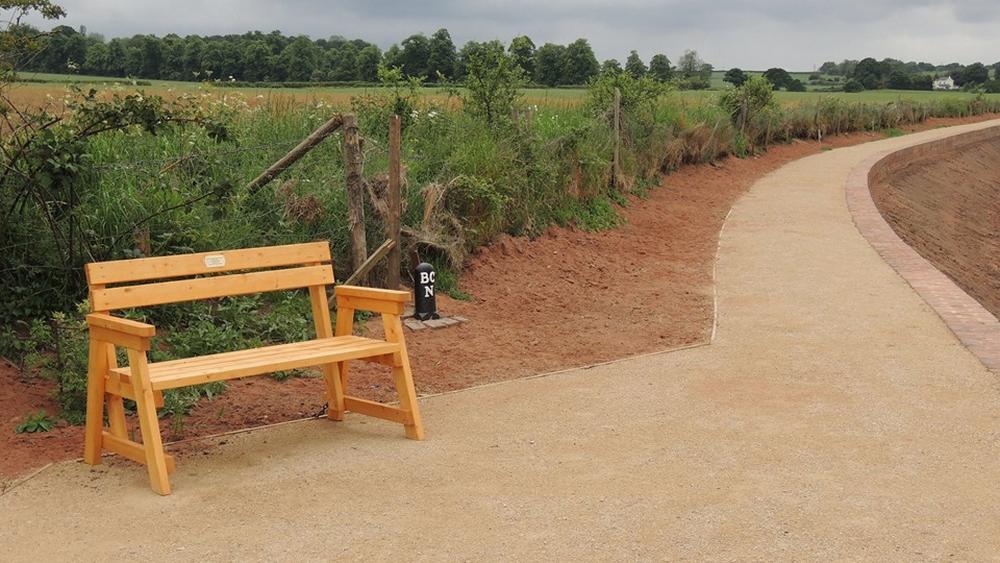
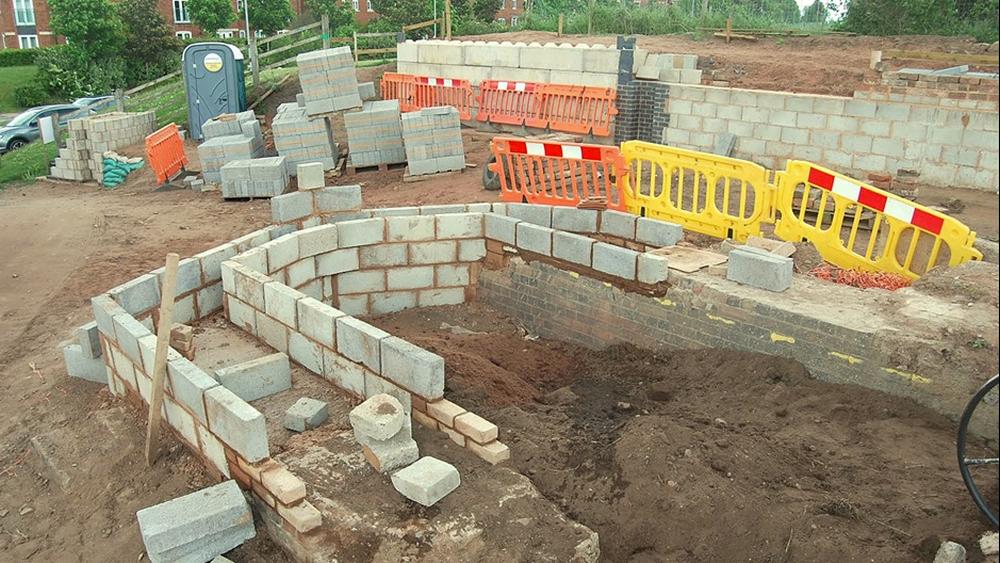
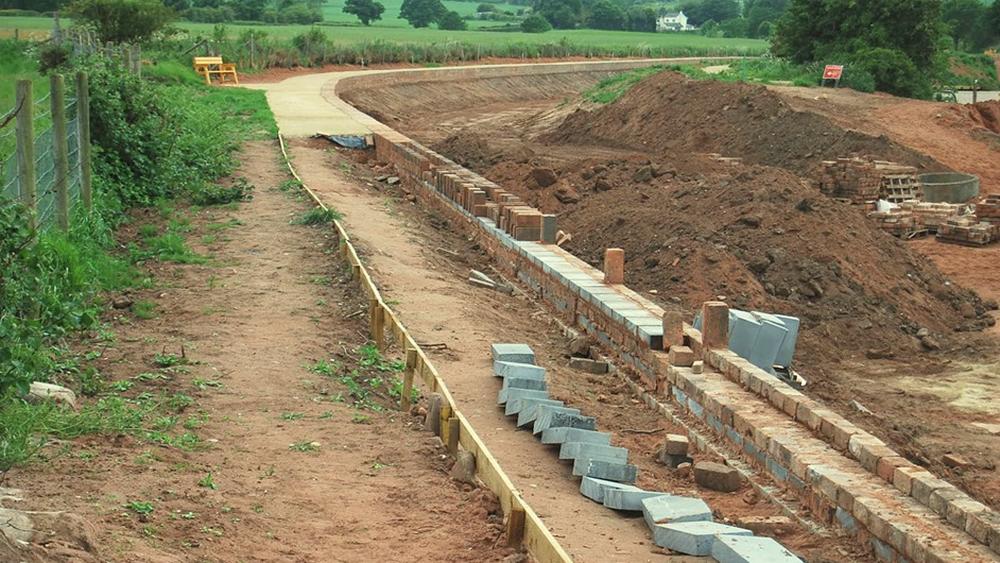
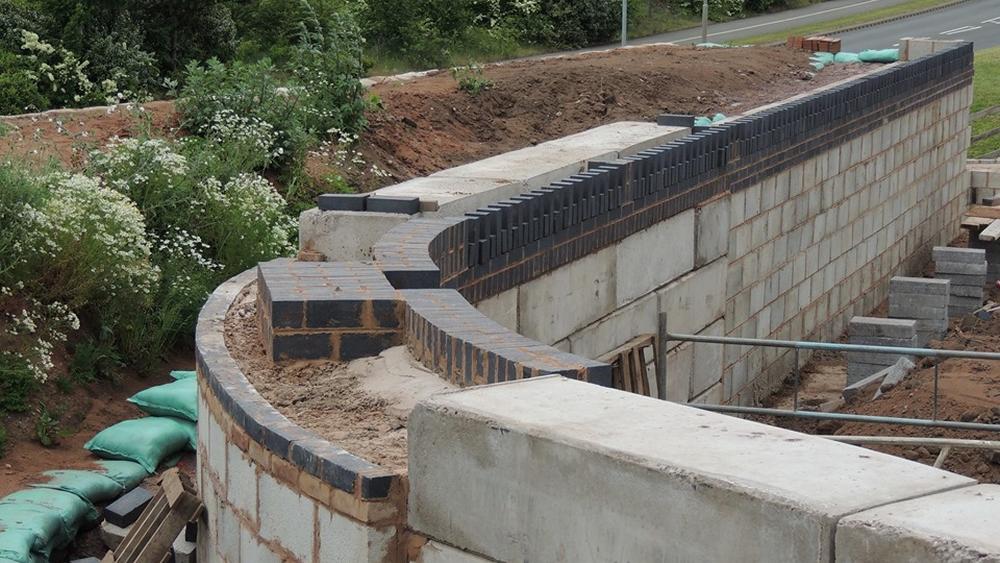
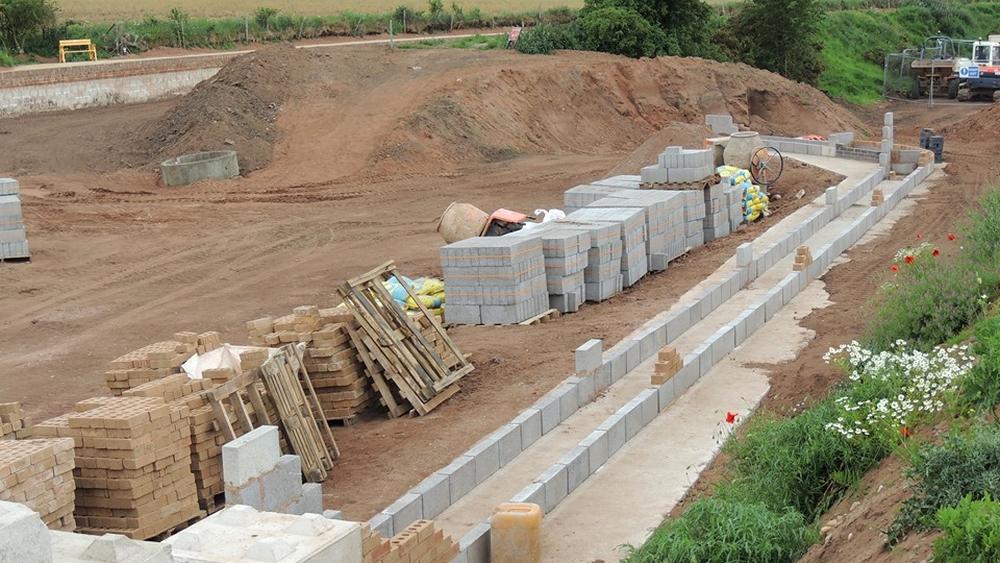
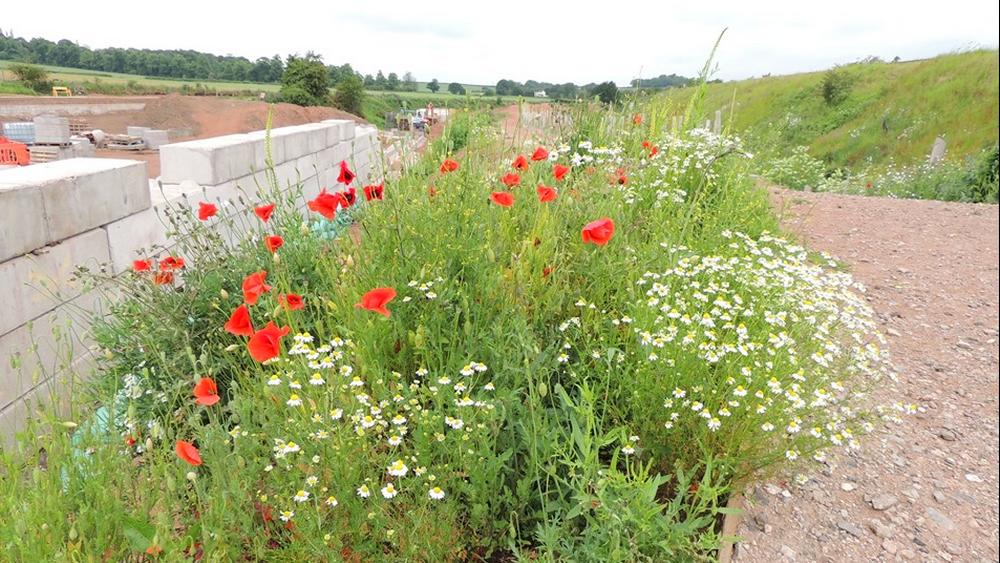
Down at the Fosseway site you will find a huge amount of work has been achieved this month. The Southern towpath wall has progressed well, within the turning pound. A few more weeks should see it's completion The walls around the turning pound are also progressing well. That which runs alongside Falklands Road is now up to full height. We have some clay to back fill in between the concrete block wall and the sand bags. Top soil will be used to complete this part of the Pound's encircling wall. This length of wall will soon be ready for the half scale narrow boat to be constructed along it's top. The wall parallel to the disused railway line, and the enclosing wall to the west of the pound, have their concrete foundations poured.
The brick laying students from Walsall College are to build the concrete block sandwich wall and fill it with concrete they themselves will mix. Again, as this wall gains height it will be back filled with sandbags, clay and sand/soil. A substantial footpath along the top of this mound will have been provided. This footpath will join up with the footpath along the Northern bank of the original canal bed eventually. Good work in the original canal bed can be seen. The full length from Fosseway Lane through to Falklands Road is now profiled to its final shape. A bit of finishing off of the wetlands area is still to be done. Soon at the our Fosseway site we can make a start on working our way along towards Claypit Lane, Permission to take over control of this length of the canal's route is expected soon. Once we start on the work alongside Falklands Road we will be in full sight of the travelling public, and then we can show just how genuine our aspirations are for the Lichfield Canal to become a reality.
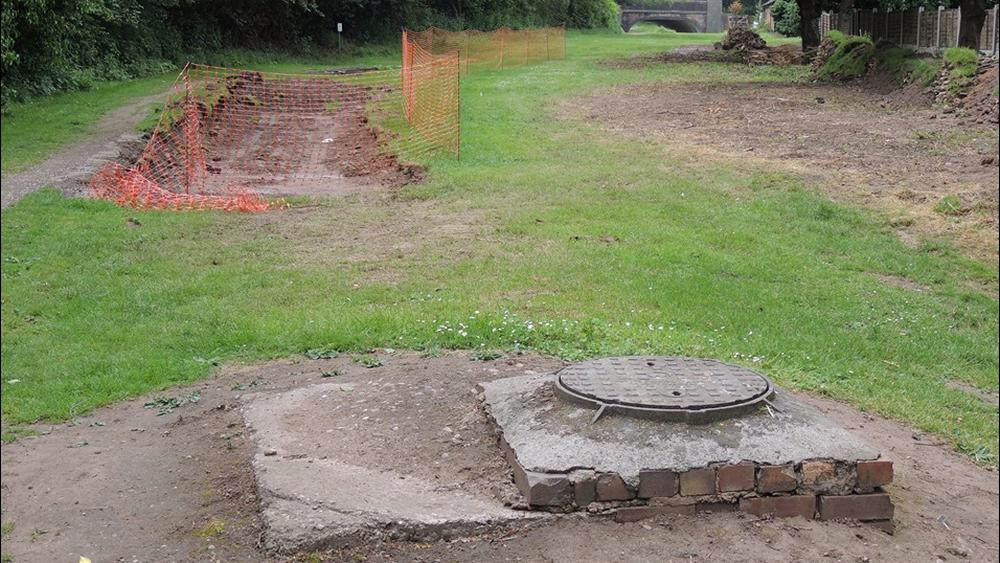
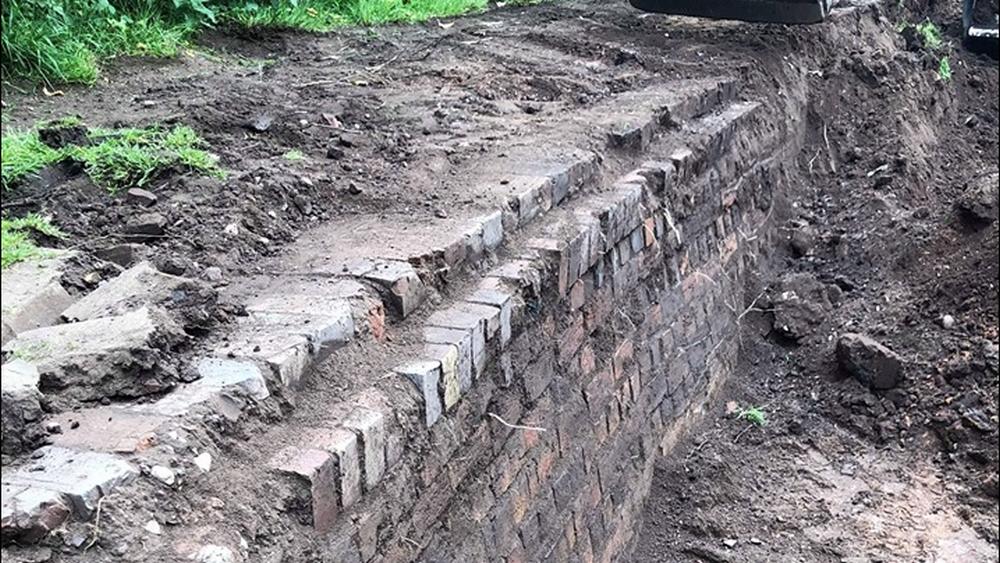
Elsewhere within the Lichfield area, work has just started between Gallows Wharf and Cricket Lane to try to establish where the original towpath wall is and what remains of it and it's condition. Having done this we can then provide a much improved walking route. The original brick towpath wall appears to be intact (so far) but of dubious standard. Again as we found at Fosseway, the towpath wall appears to be constructed with no mortar between the bricks!.
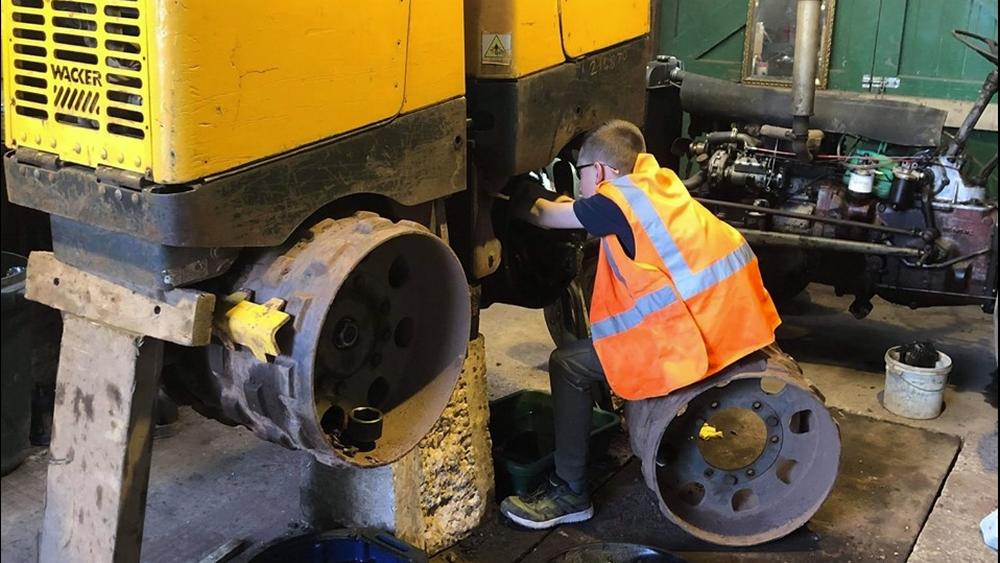
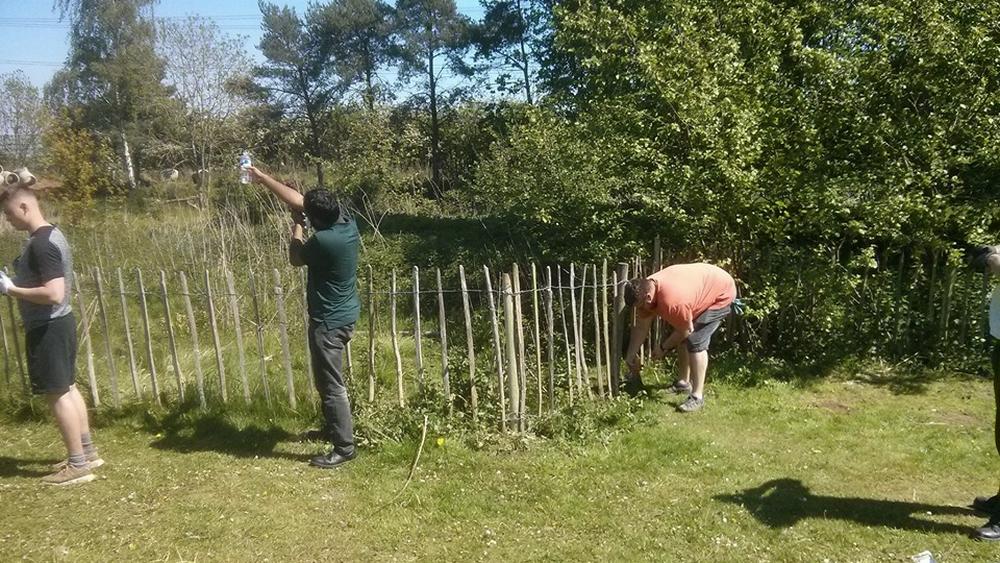
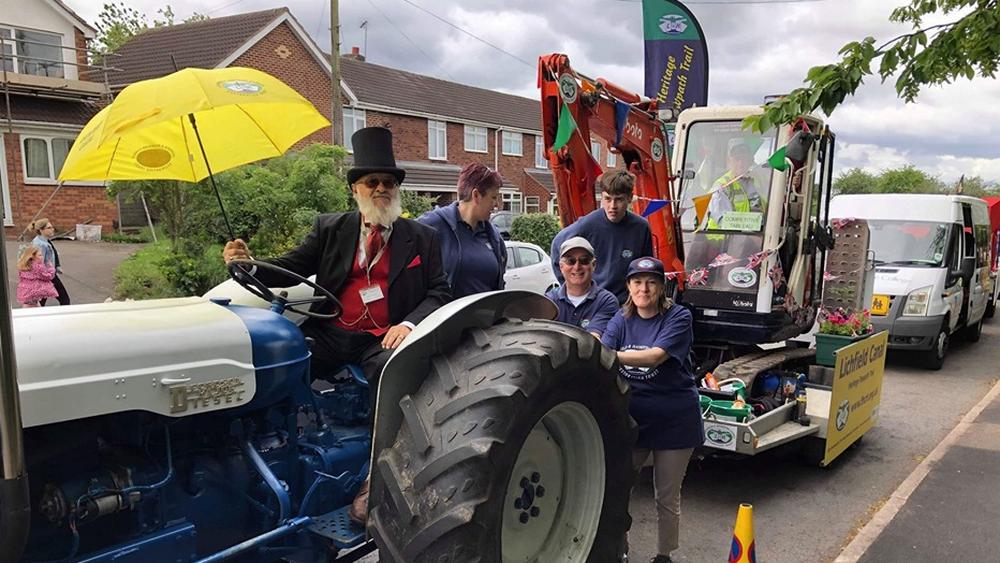
Work in Darnford Park by corporate volunteers have re-established the chestnut picket fence around our workings. Down the Tamworth Road compound a lot of activity at the weekends takes place. The restoration of an old trailer for future use to transport our 5 tonne digger or sections of the big pipe continues. The preparation of our 3 tonne digger for the Bower Procession and many other jobs takes place. Not to forget the maintenance and repair of our ageing plant. I thinks that's it for this month. Thanks to all our helpers and volunteers. Keep up the good work! Hugh Millington

The Need For Quality Control
Our volunteers can be just about anyone. Skilled workers, college students,
corporate volunteers. work experience young people, Duke of Edinburgh
youths, retired people from all walks of life etc. etc.. There is a good mix of
people who volunteer to help us rebuild the Lichfield and Hatherton Canals.
Some are young and fit, others are old and fit. Some can give only one or
two days a week helping. Some want to get involved to a greater extent in
the overall running of this Canal Trust, some don't. And even some just come
down for a chat.
It's not surprising that differences of opinion at the work place occur from time
to time. Some want to do it this way and some want to do it the other . We
are human beings after all. Some think they know best, some are just happy
to do what they are asked to do and get on with it.
But there has to be structure somewhere down the line. And here we are
very fortunate to have Peter Buck as Engineering Director to keep us on the
straight and narrow when differences of opinion arise.
There are times when we have to question the quality of work that our many
and varied volunteers produce. With volunteers from so many different walks
of life and backgrounds it is perfectly understandable that standards will vary.
It is essential that we maintain standards. Poor and faulty workmanship will
do us no favours in the long run. Our work will be on show for, hopefully,
many generations to come. We must maintain standards of workmanship
whether it's produced by an individual volunteer or by a group of, say, College
student volunteers. We all have a responsibility to the Trust and our fellow volunteers to
maintain standards.
Hugh Millington