Lichfield Canal Restoration: Huddlesford to Fosseway Lane
As we entered 2022 Duncan Moore asked LHCRT engineering director Peter Buck about what is needed to complete the restoration of the Lichfield Canal from Huddlesford through to Fosseway Lane.
Much of the Trust's plans are based on the Lichfield Canal Feasability Study by W.S.Atkins of 2009, and the asscociated maps.
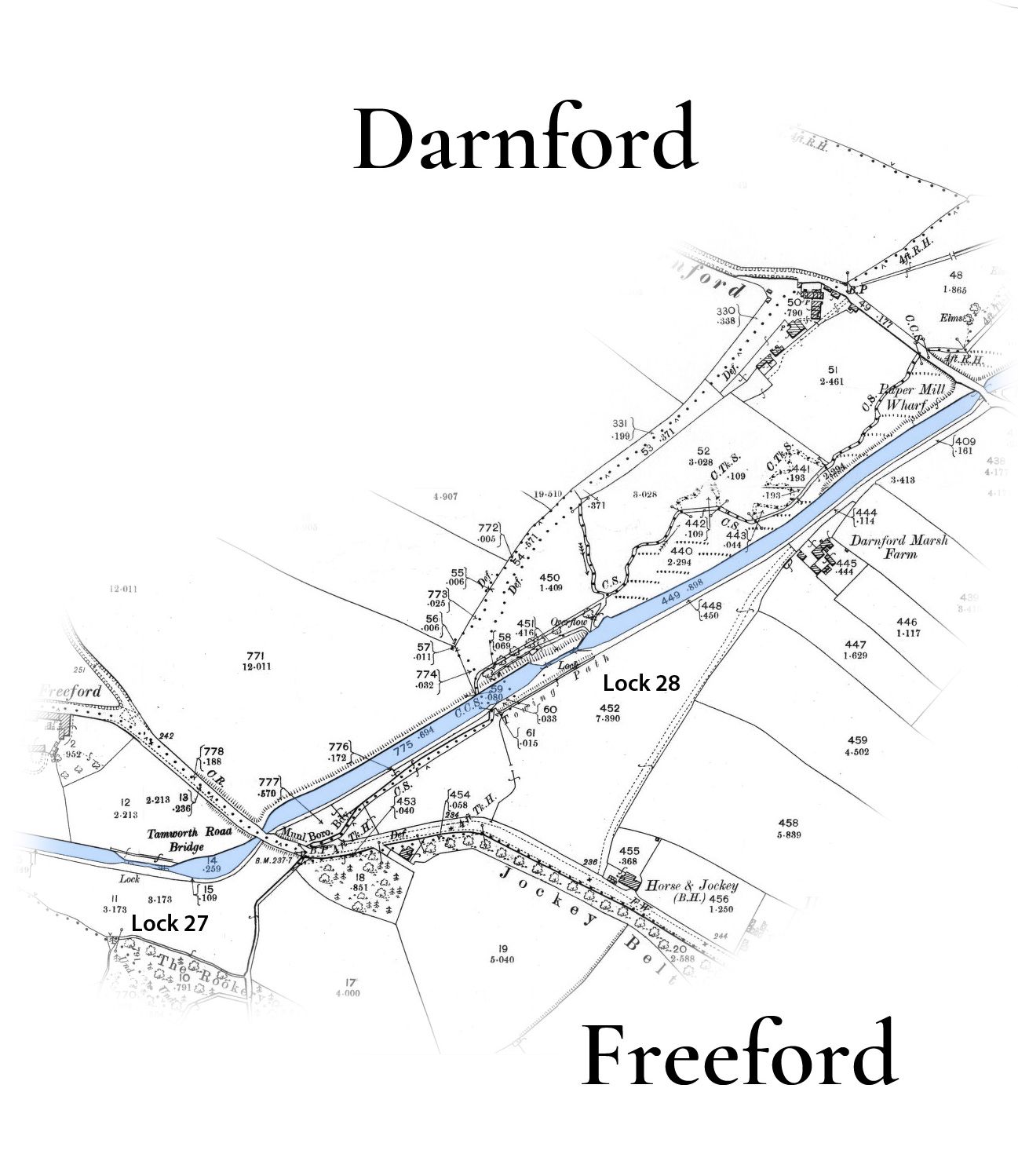
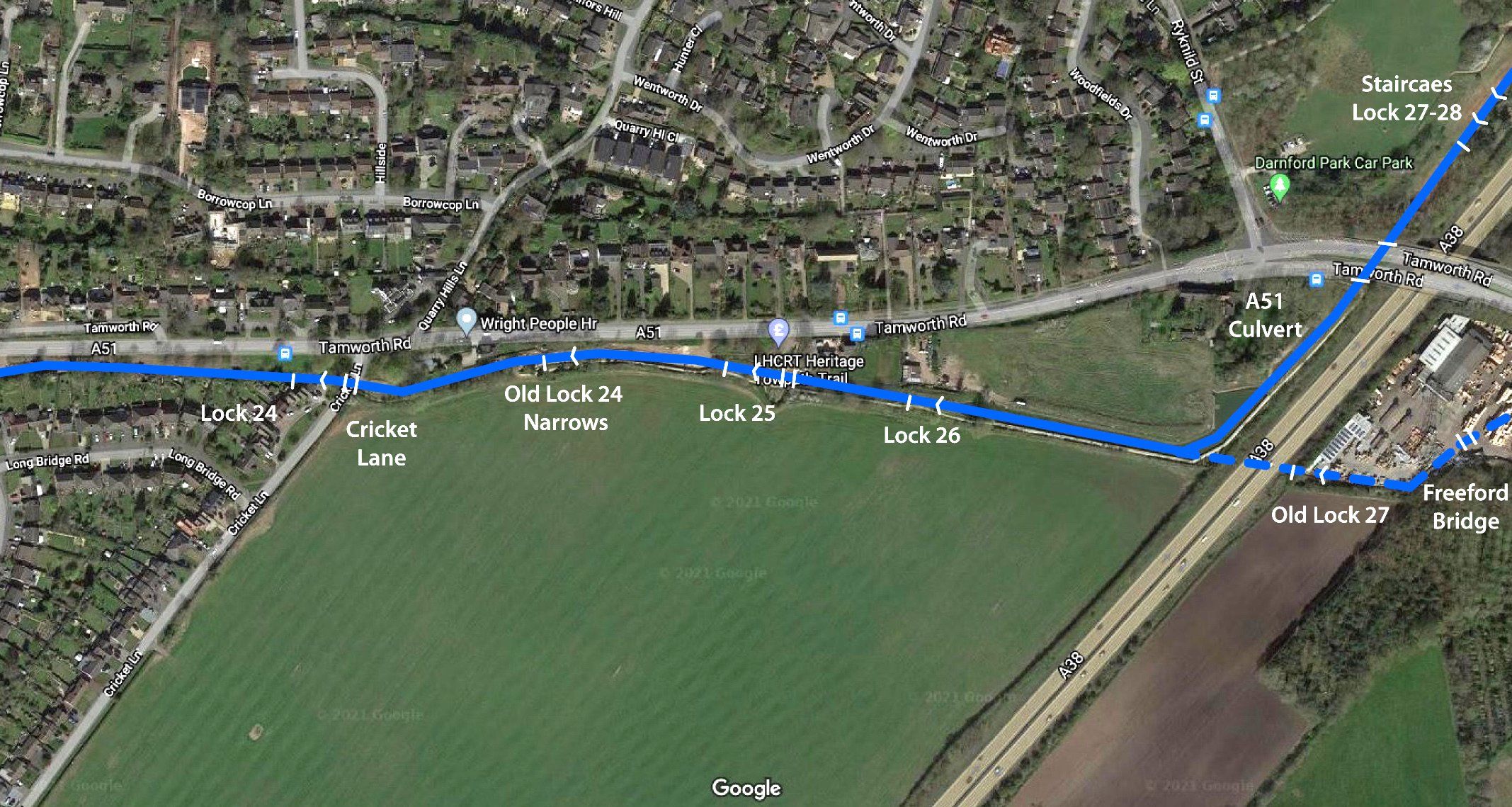
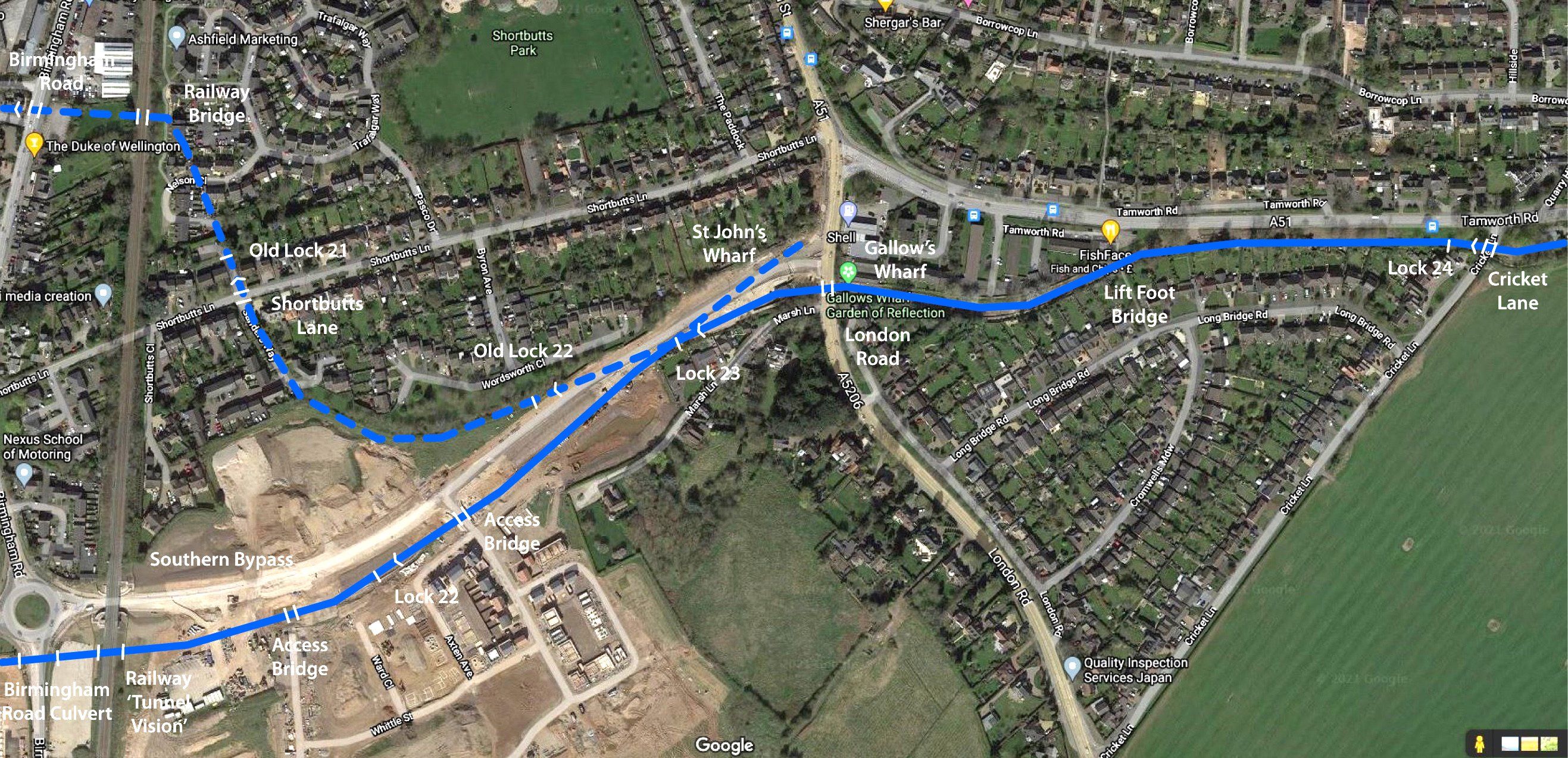
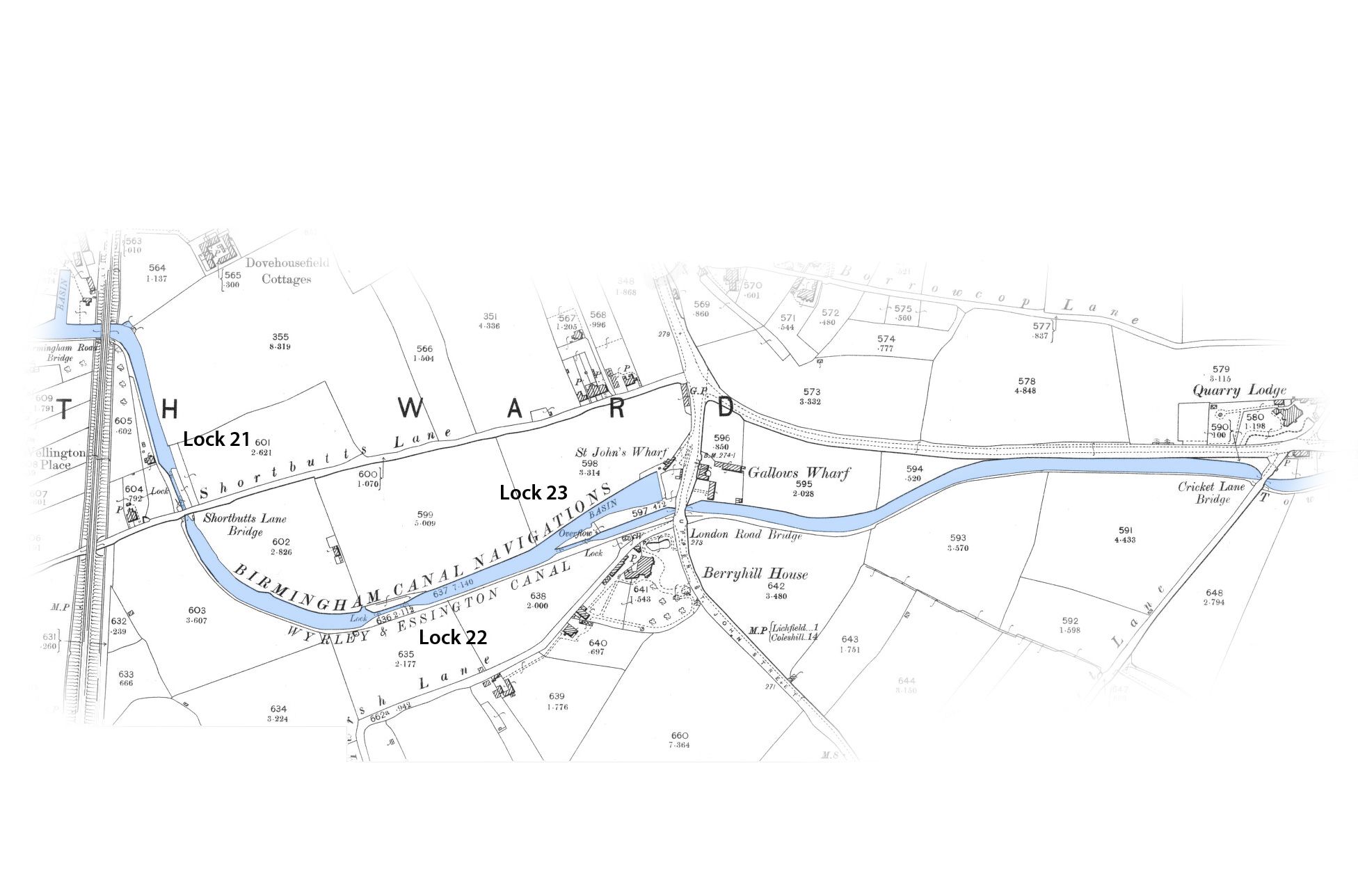
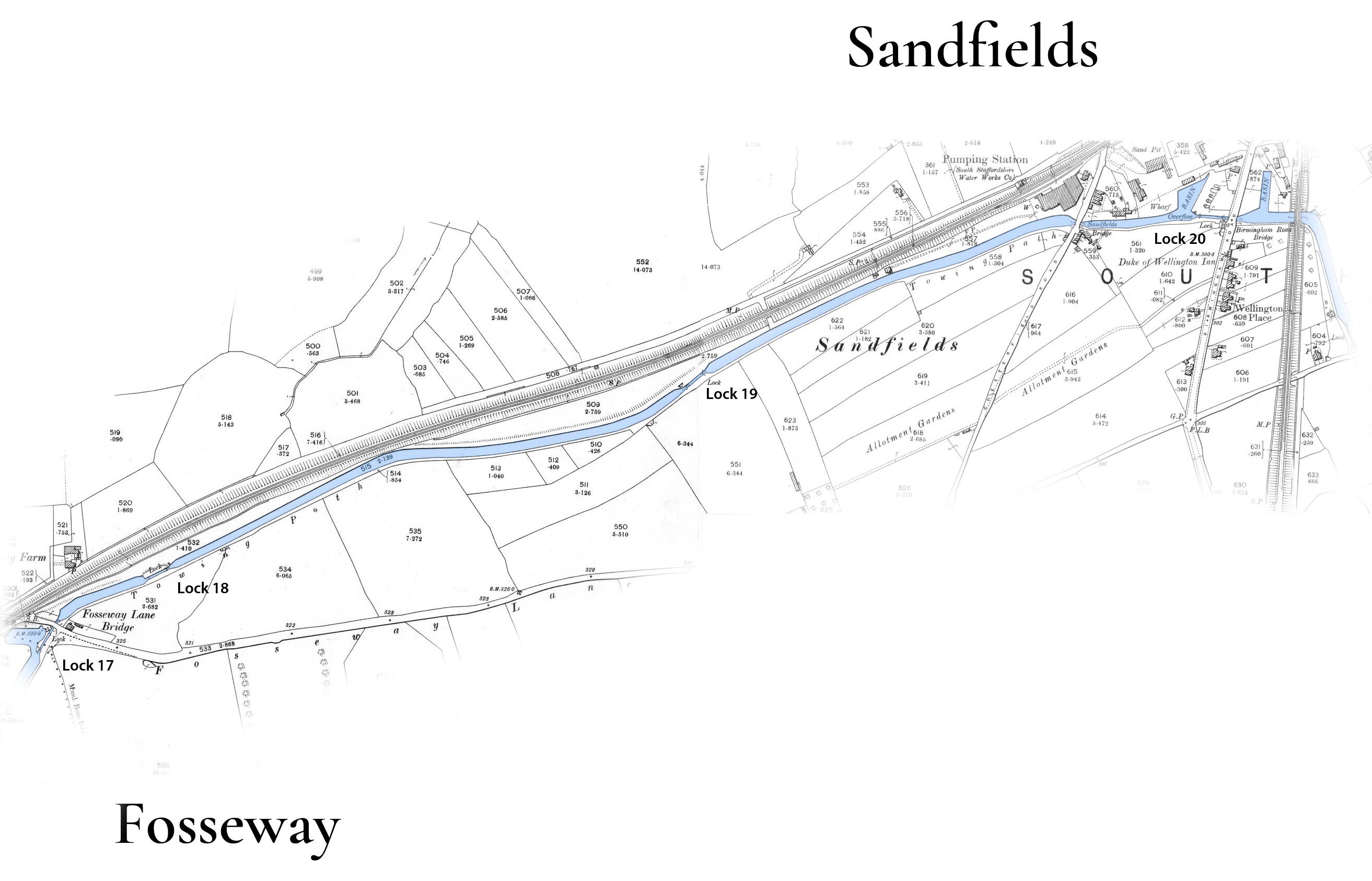
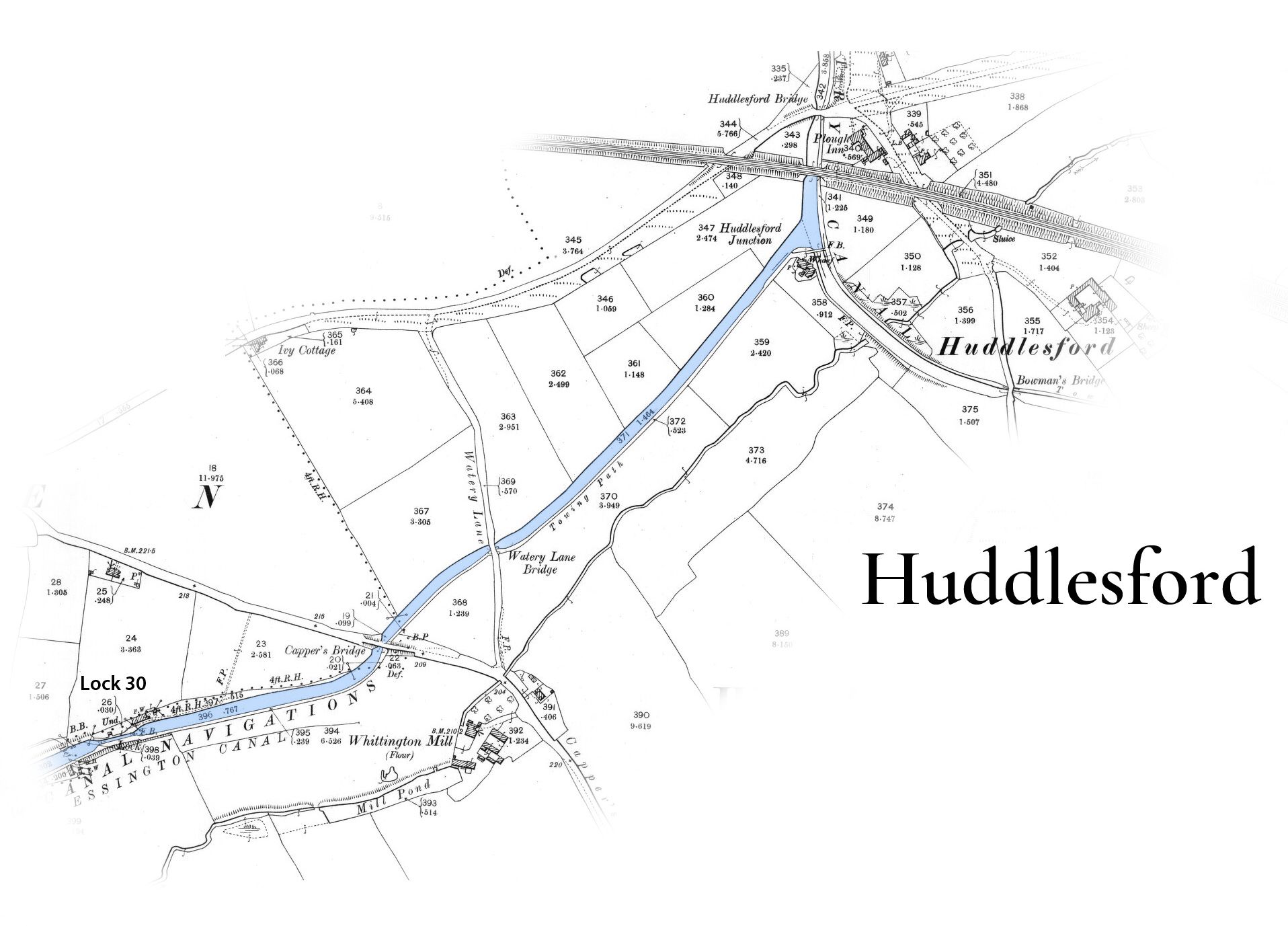
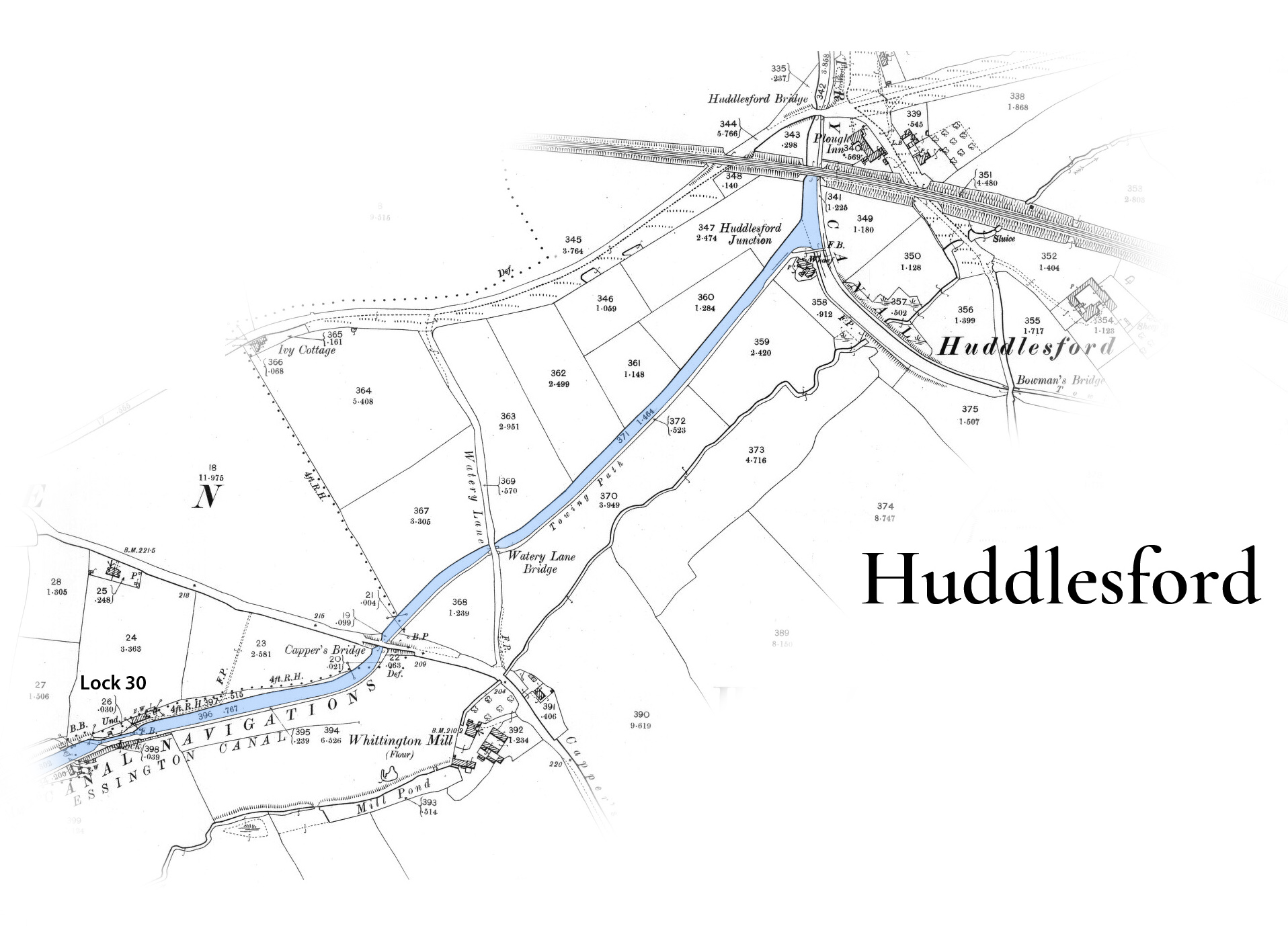
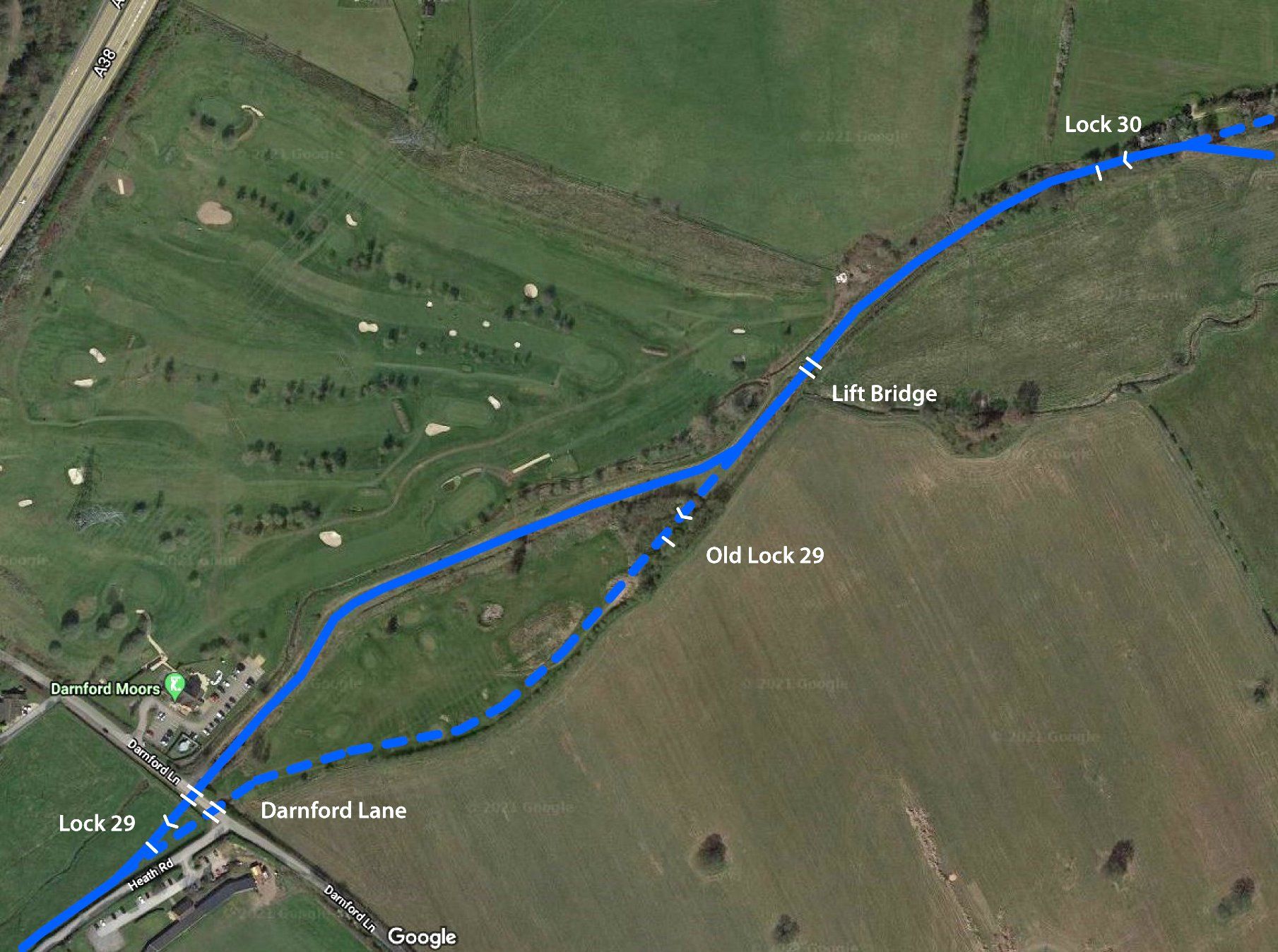
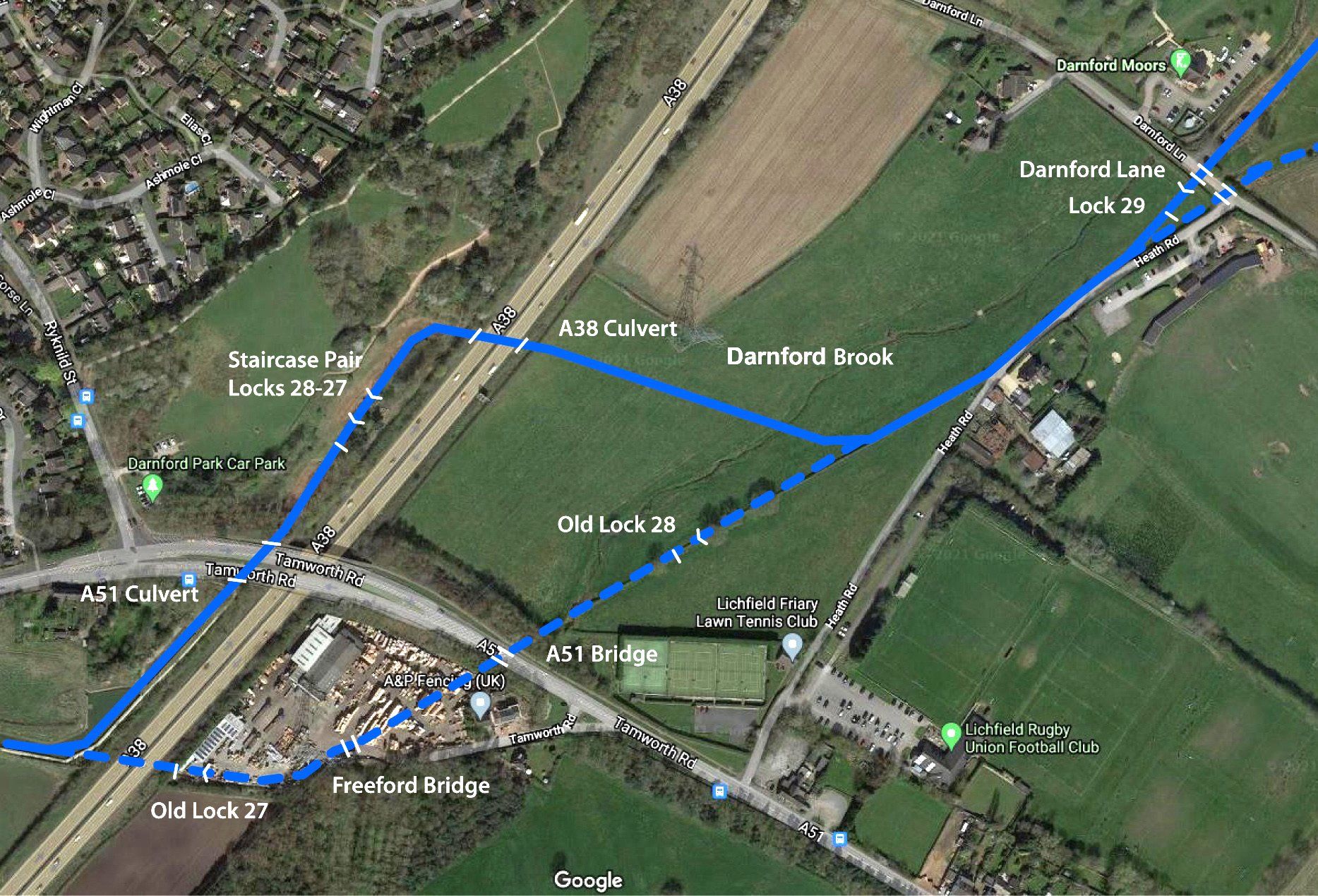
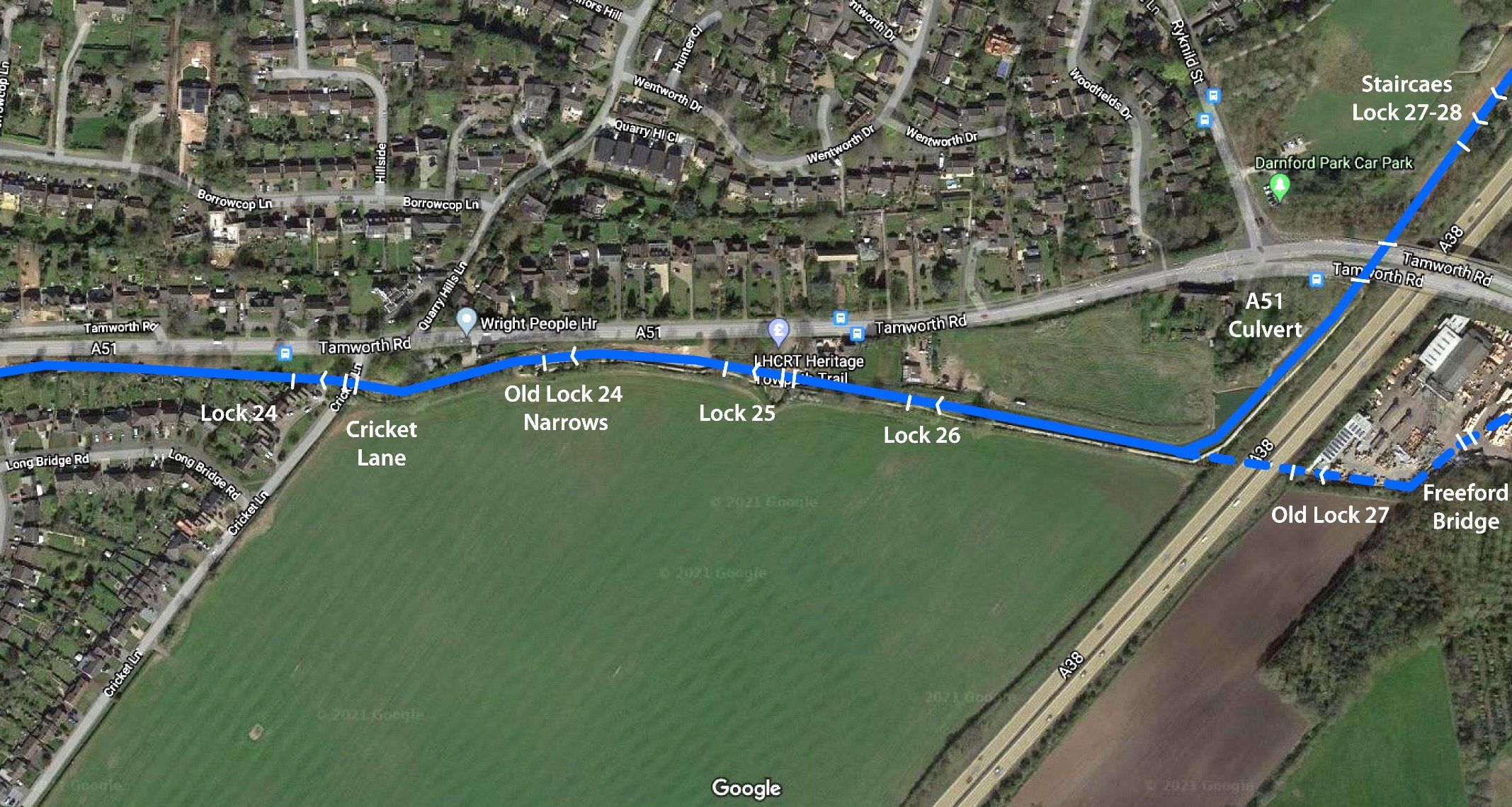
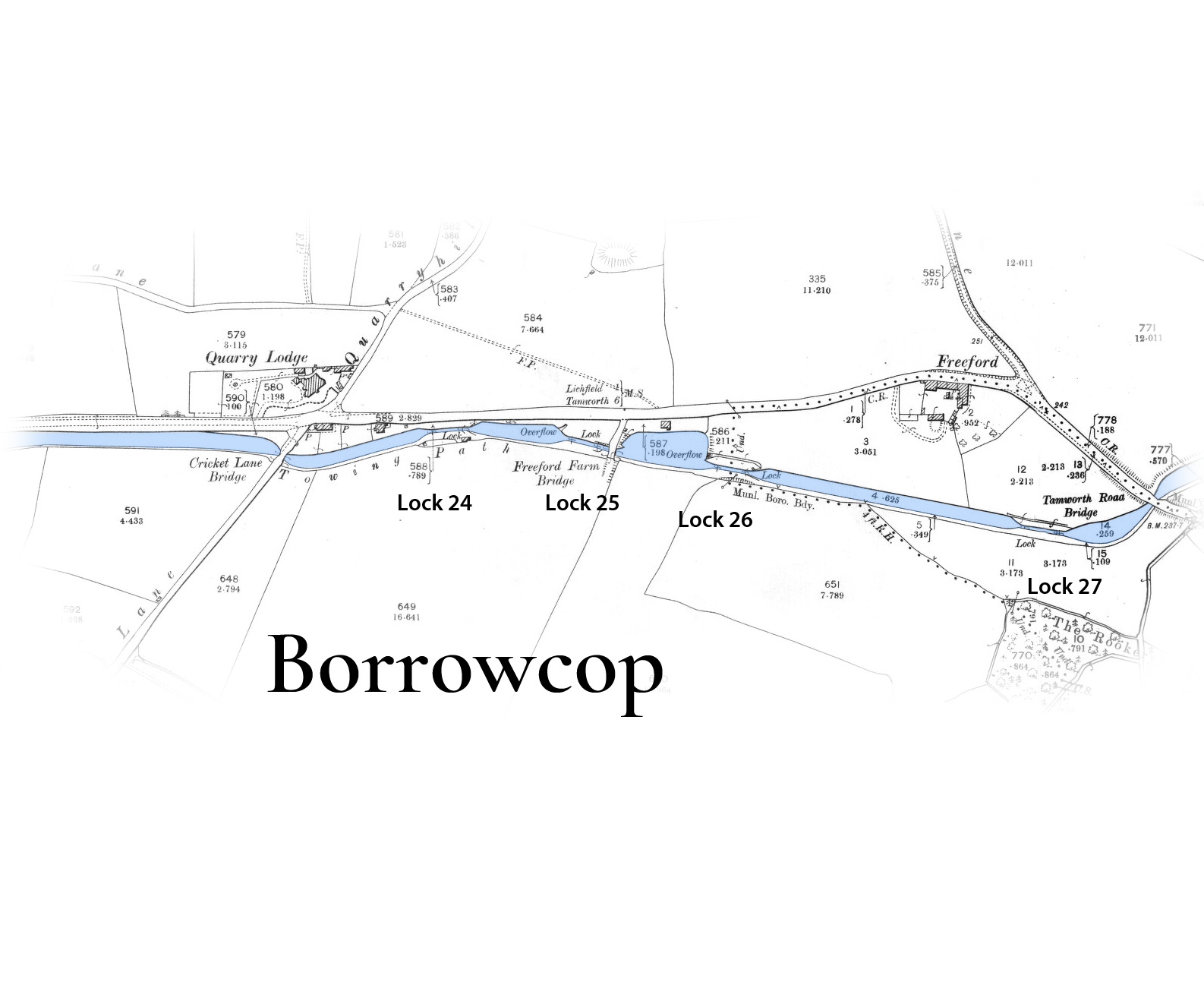
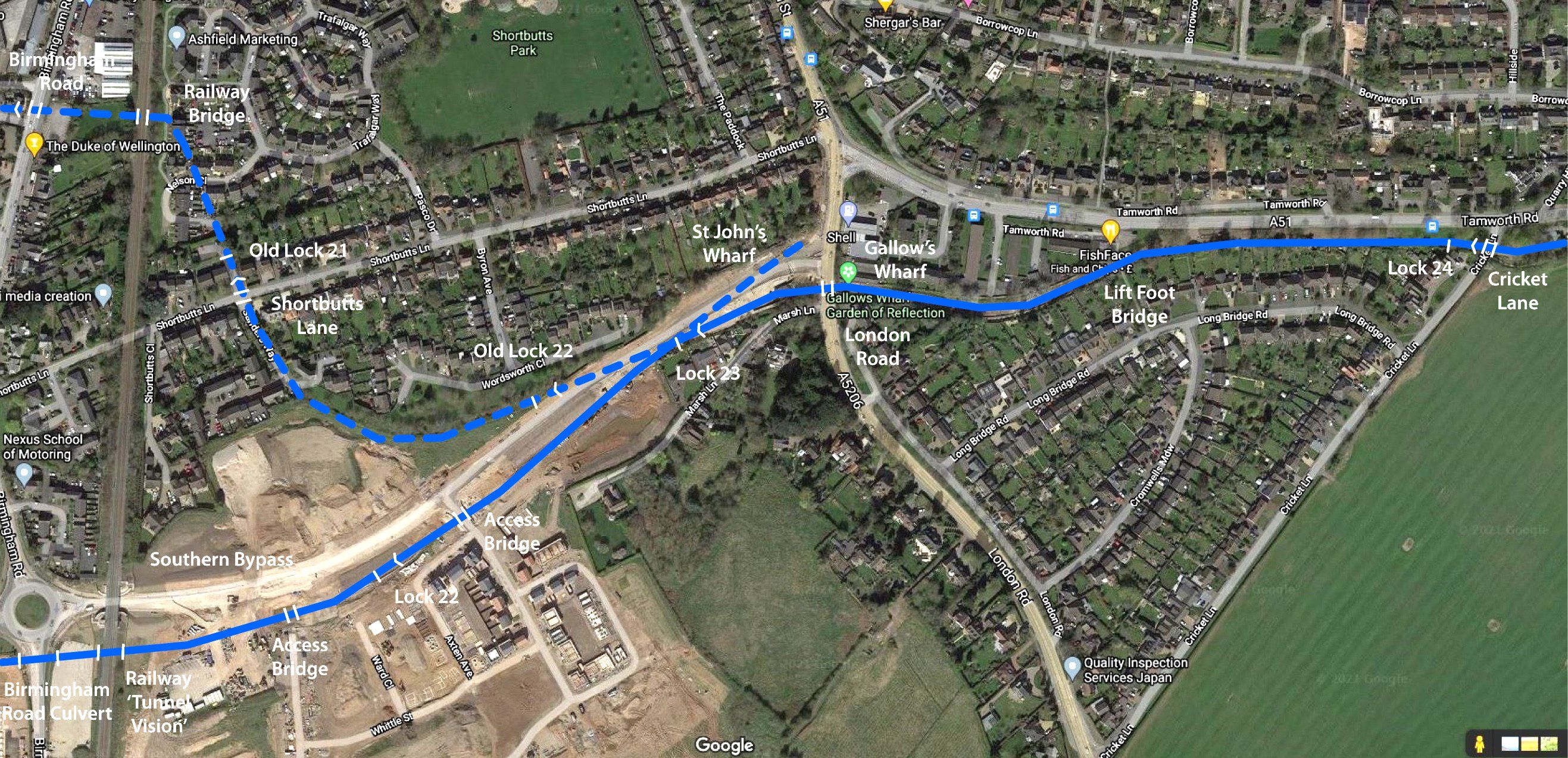
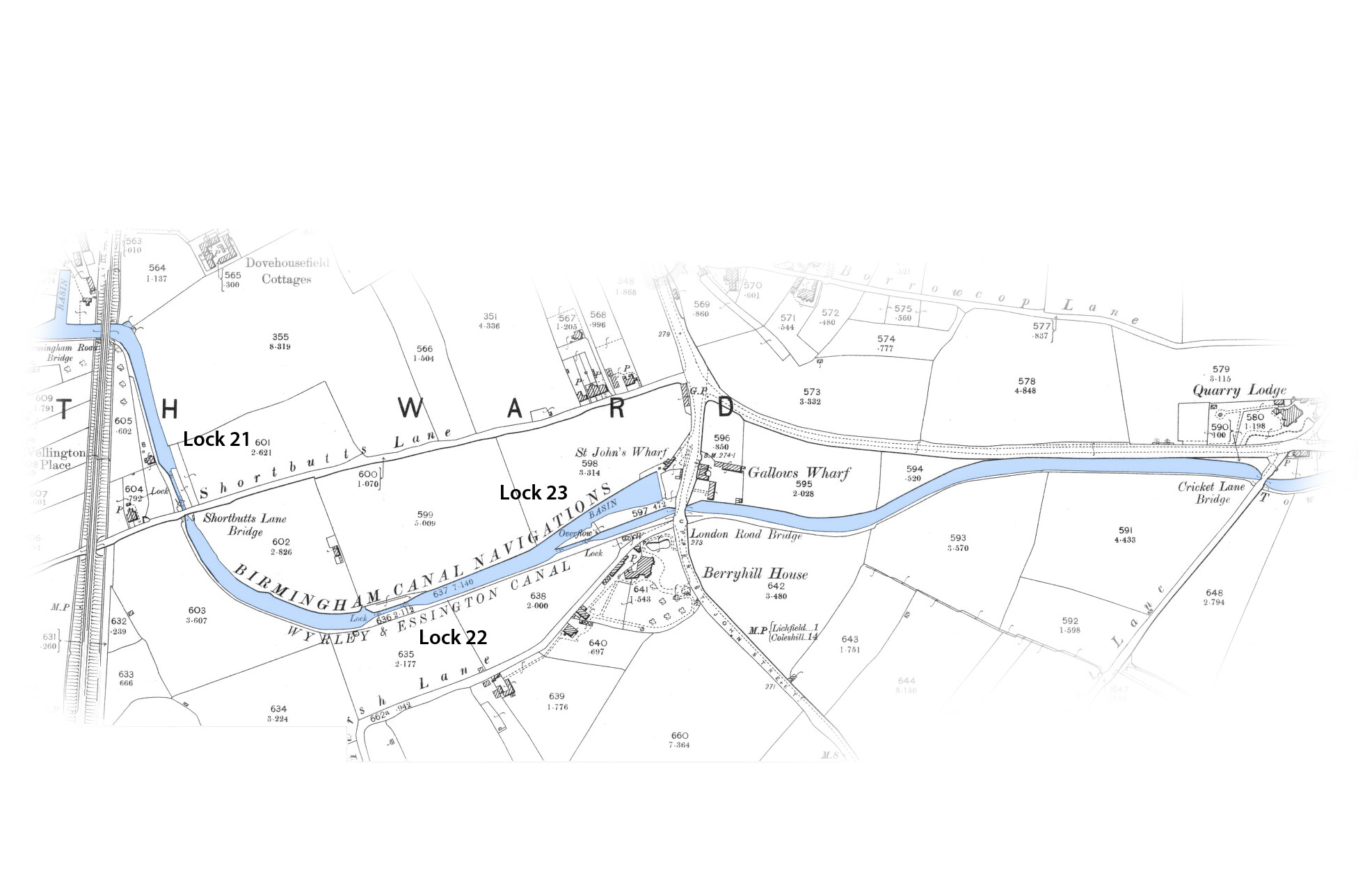
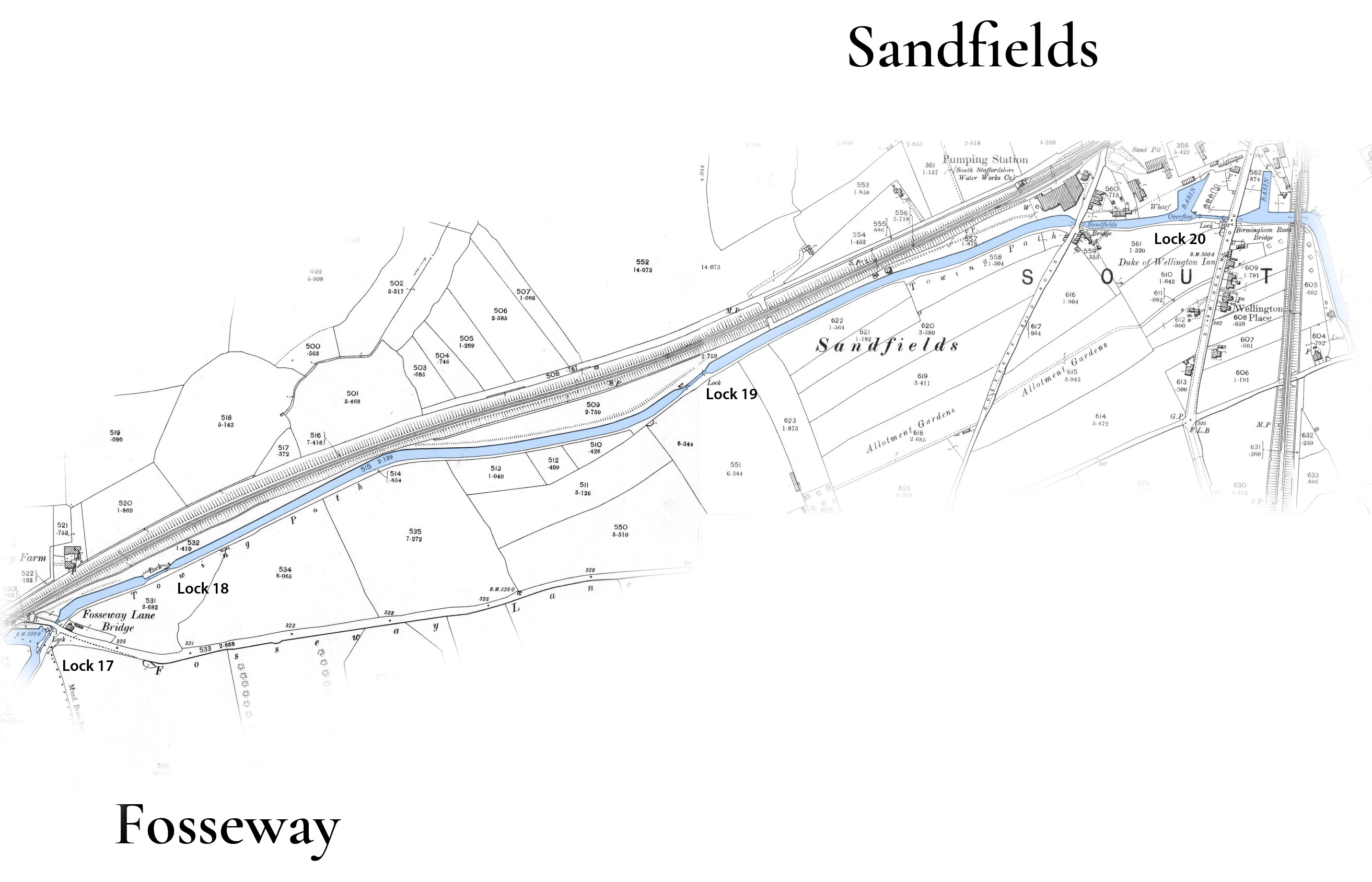
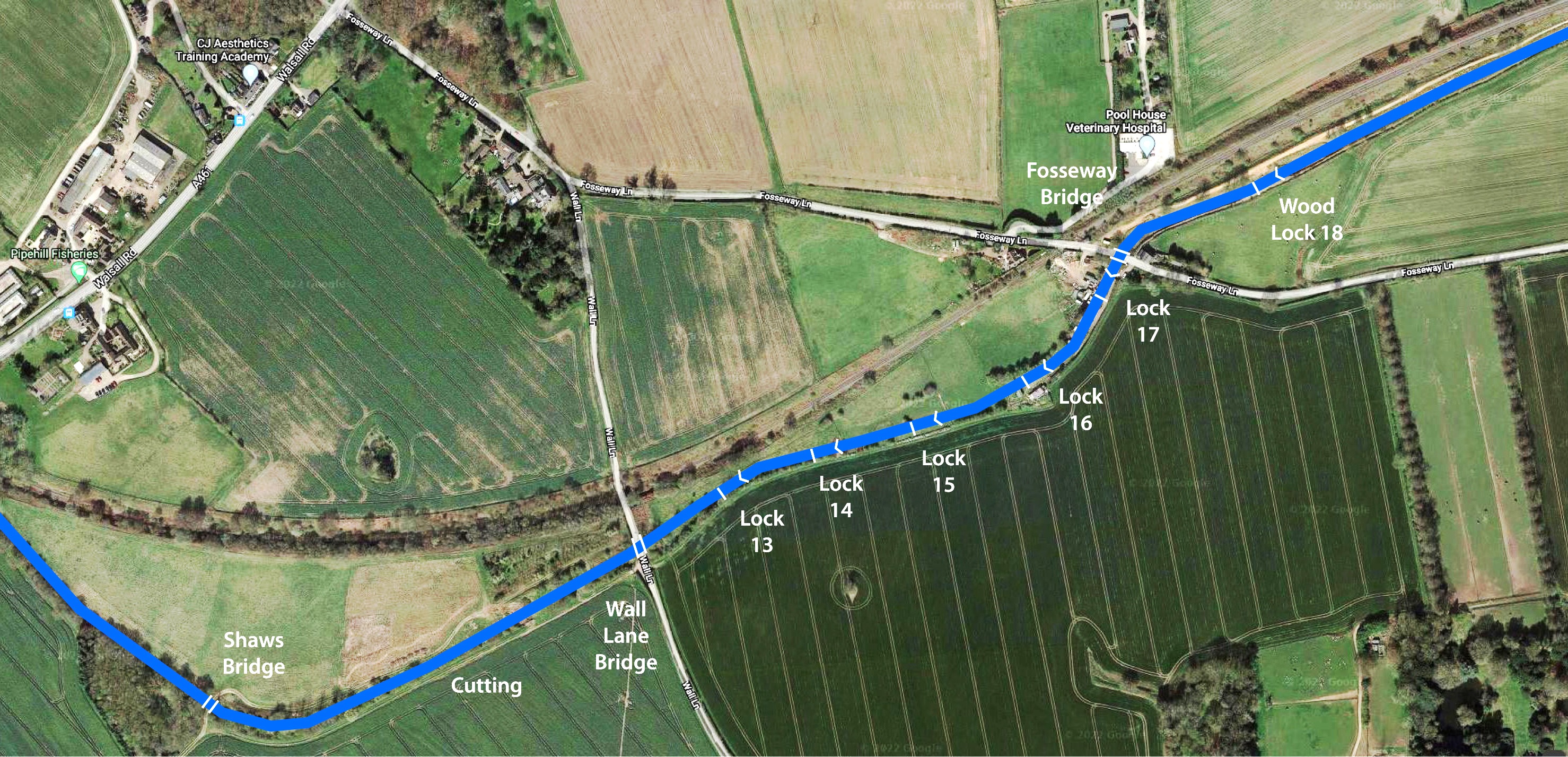
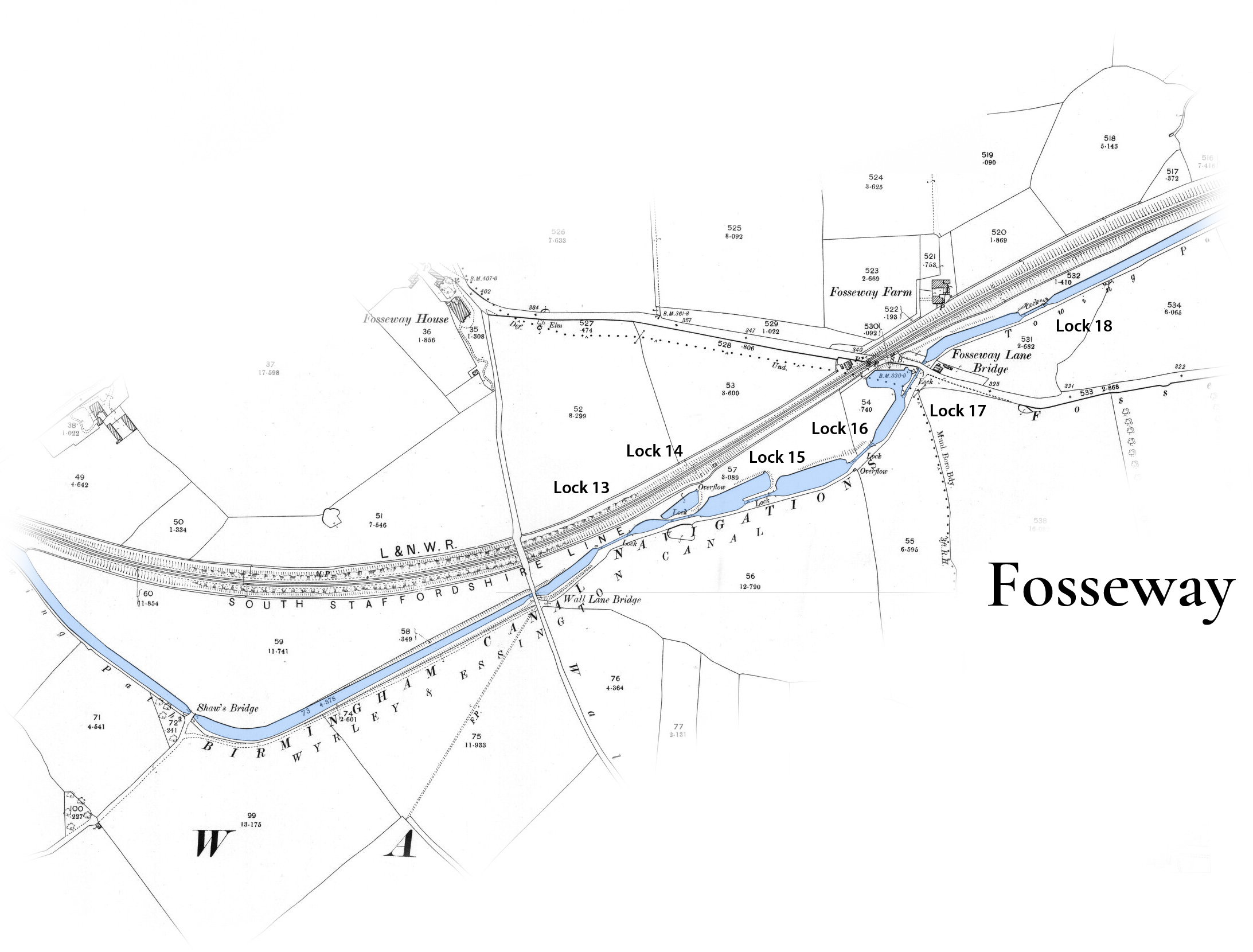
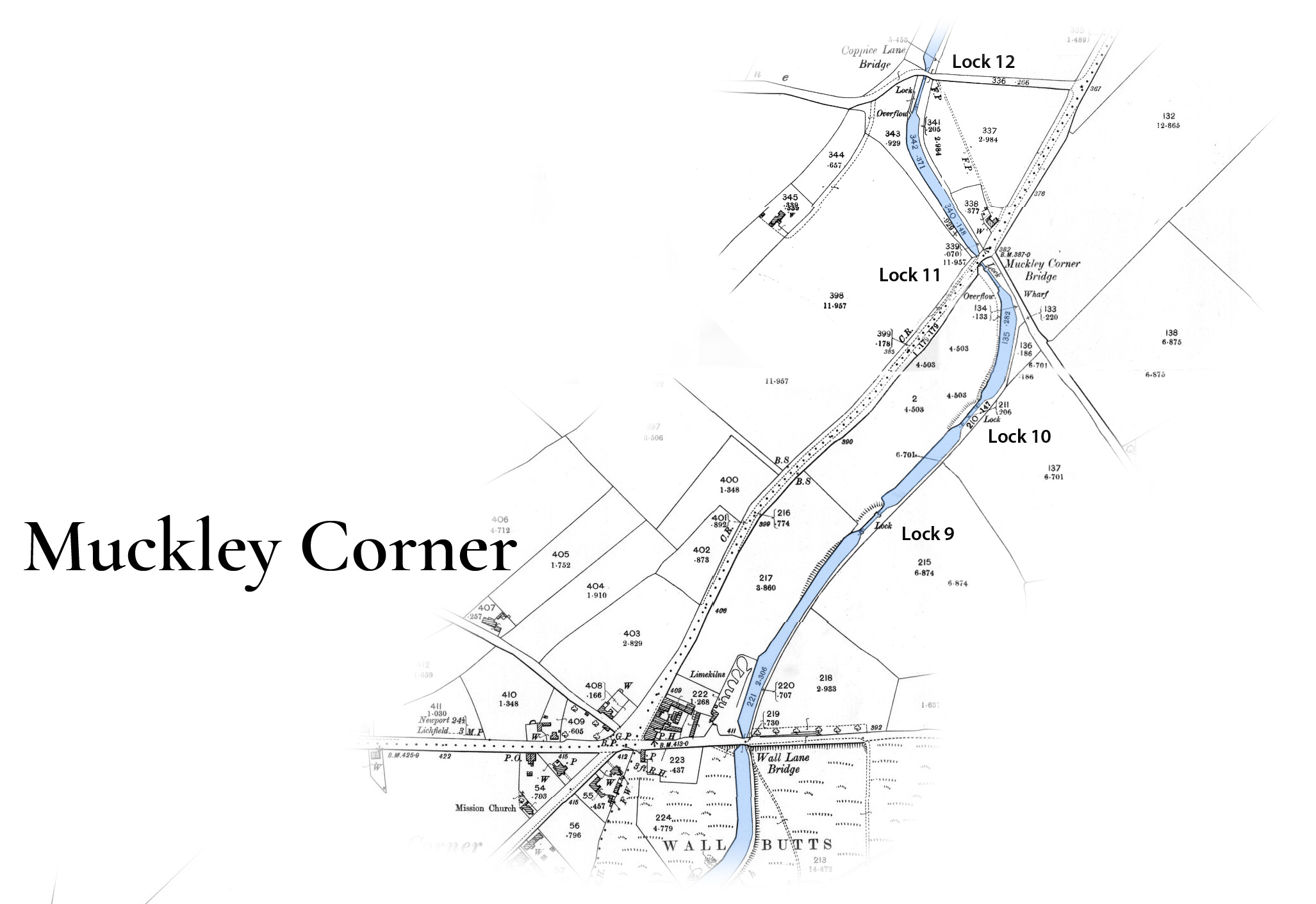
Google Imagery from 2021 can be compared here with Ordinance Survey 25 inch to 1 mile maps from 1920.
Maps prepared by Duncan Moore. Click to enlarge.
The first length of canal from the junction at Huddlesford as far as Cappers Lane
is in water and used for moorings for about 70 boats by the Lichfield Cruising
Club. This length includes the only surviving brick arch bridge on the Lichfield
Canal, Watery Lane Bridge. However, the peace of this rural stretch running
through fields is about to be shattered by the arrival of the HS2 High Speed Rail
Line.
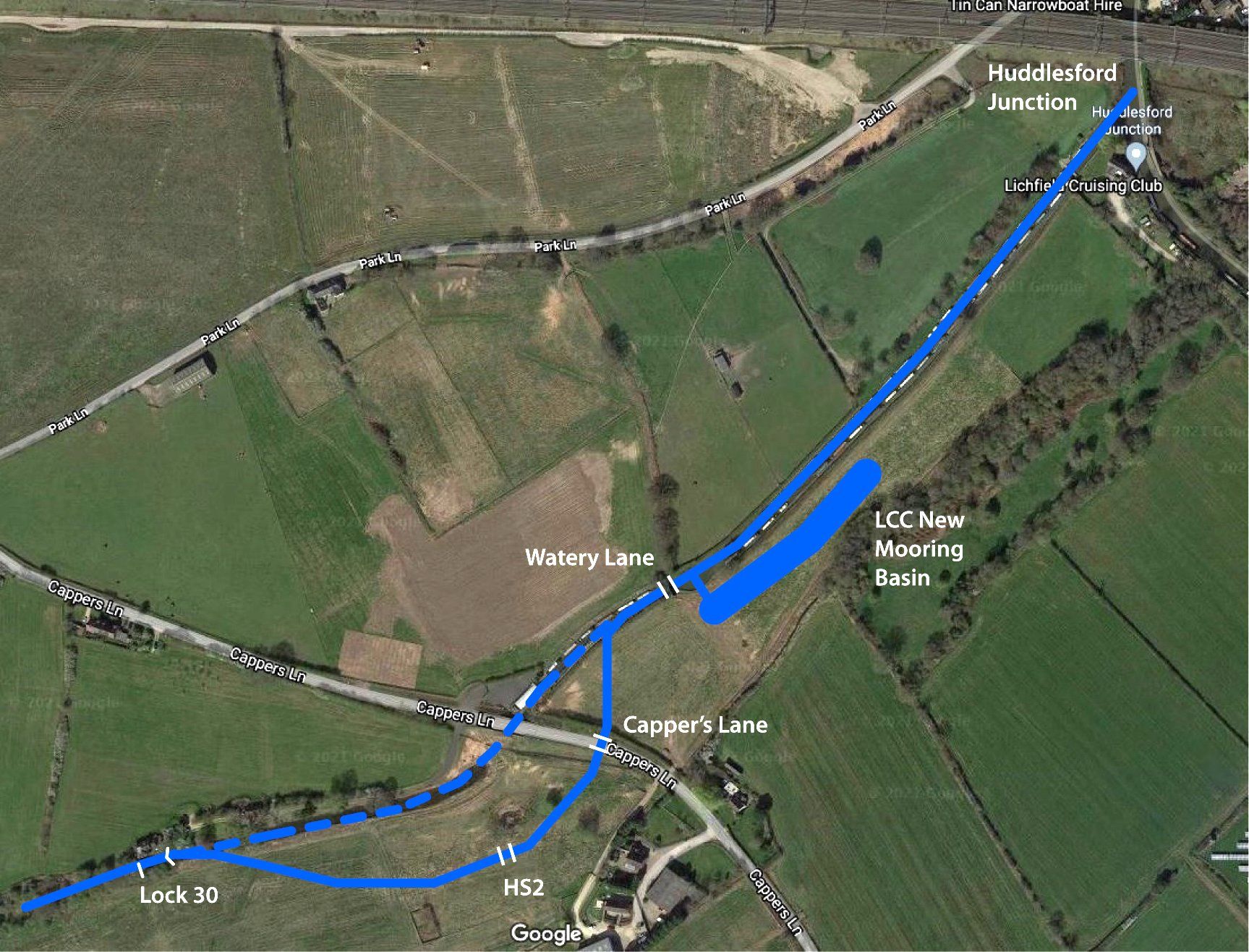
As part of the construction of HS2 a new mooring basin is currently being dug
on the south side of the channel which will accommodate about 20 boats. To
open up this length for public cruising, that basin will have to be considerably
enlarged by the Trust to accommodate the remaining boats.
Beyond Watery Lane Bridge stands the rebuilt Cappers Bridge. Sadly this
structure will never see the passage of a boat as this is where HS2 will cut
across the canal. The Trust has successfully negotiated that HS2 will divert the
canal in a gentle loop to the South of its current line. A third Capper’s Lane
Bridge will be built before the new channel passes under the HS2 viaduct, re-
joining the original line just below the bottom lock, Lock 30. This work will be
carried out by HS2 in the next couple of years.
The Trust have purchased the line of the canal from here onwards, including
Lock 30, but agreement will need to be reached with neighbouring land owners
before this section can be reopened. It may be necessary to resite Lock 30
slightly above its current location towards the new lift bridge.
The next section has seen considerable work from the Trust in the past, including
the reinstatement of the Darnford Brook culvert, installation of the new lift bridge,
and excavation of a new channel from just below old Lock 29 to Darnford Lane.
Further work will be required on this length to adjust the levels and profile of the
new channel, with further work to strengthen the piling.
The old bridge at Darnford Lane sat right on the junction with Heath Lane. The
new bridge will be located slightly to the NW of the old bridge and at a lower level
since the old lock 29 will not be used. The concrete sections from which the new
culvert will be formed are already on site waiting to be installed under the
roadway..
Beyond the road crossing will be a new lock 29 which will return the canal to its
original level and allow it to re-join its original course for about 100m alongside
Heath Lane. Further challenges on this length are that Darnford Brook is
environmentally sensitive and there is a very narrow corridor for the new crossing,
channel and associated earthworks.

Beyond that heathland, the canal will again leave its original course and turn to
the West just before old Lock 28. This new route will bypass the two former
bridges at Freeford, old locks 28 and 27 and the A38 crossing. The new
alignment will have to cross Darnford Brook, either with a syphon or the brook
flowing through the canal. This will require negotiation with the environment
agency and present the opportunity for creation of new wetlands. Once again,
the Trust will need to identify a solution which is also acceptable to local land
owners.
The canal will then pass under the A38 in a new box culvert. Whilst this is a
major financial challenge for the Trust, it should be remembered that the
Cotswold Canal Trust has very recently overcome a similar obstacle to
restoration on the A38 many miles to the south. The culvert needs to be aligned
to ensure there isn’t too sharp a turn as the canal emerges on the North side of
the road.
The new line will then rise through a staircase pair of locks before a new box
culvert under the A51. These locks may employ a back pump to reduce water
consumption. Some excavation has already been carried out by the Trust in this
area. The A38 marks a transition for the canal from open farmland to the rapidly
expanding outskirts of the city of Lichfield.

To the south of the A51 the line comes to the restored section at Borrowcop
including Locks 26-25. All that’s required here are new gates for the locks.
However the top lock of this flight, old Lock 24, cannot be restored. This is
because Cricket Lane used to cross the canal on a hump backed bridge a
short distance above the lock. It’s not possible to reinstate the bridge at its
former level and so Lock 24 will have to be relocated to the other side of
Cricket Lane so the canal can pass under the road.
This will require the lowering of the channel between old Lock 24 and Cricket
Lane. This, in turn, is complicated because the original alignment of the lock
would mean the channel beyond would undermine the bank and lock cottage
above. Old Lock 24 will survive as a narrows, widened at the upper end to
allow boats to turn into the new lower channel above. New buttresses are
currently being built using reclaimed material from the lock to support the
walls, bank and cottage lock.
The channel beyond Cricket Lane is currently being dug out to its new, lower
level. The new culvert under Cricket Lane will be built by Persimmon Homes
as part of a new development nearby in the next couple of years. The Trust
will then need to build a new Lock 24 beyond the crossing to bring the canal
back to its original level, avoiding the electricity substation and the services
in the area.
The canal now runs through residential housing. Above the new lock 24 the
old channel needs to be dug out to join up with the recently completed
section running up to Gallows Wharf. It’s hoped this work will start very soon.
This section contains the only footpath to cross the Lichfield canal and the
Trust have built bases for a new lift bridge which will become a feature on this
length.
After passing under the surviving London Road Bridge the channel will be re-
excavated as far as lock 23. All the land from here up to the railway is
currently being made over to the Trust from Persimmon homes. Lock 23 will
be used in the restoration, but due to the new Lichfield Southern Bypass
there would not be room for boats to exit the top of the lock on its current
alignment. The solution is to build a bend into the top of the lock to allow
boats to leave at a different angle and continue into the new pound above.
From here to Old Lock 19 the canal will follow a completely new line as there
has been considerable construction on the original route, including old Locks
22 to 19, rendering it unrestorable. The first section of this new route up to
the railway has been roughly dug out and two new access bridges to the new
housing estate built by Persimmon homes. This section will require final
profiling, lining and the building of a new Lock 22.
A further challenge will be draining the rather boggy land to enable the works
to be carried out. We are grateful to Persimmons homes who have greatly
helped the restoration of the canal here.
This brings us up to the railway. It was hoped that a tunnel under the railway
could be installed at the same time as the bypass was built with massive
cost savings, but in the event this was not possible so a new tunnel under
the railway will have to be provided. The ongoing Sir David Suchet appeal,
Tunnel Vision, can be found elsewhere on this site. Immediately beyond the
railway, a culvert has already been installed under Birmingham Road and its
roundabout with the bypass. This has temporarily been buried but will
ultimately connect to the new tunnel under the railway.
Beyond the tunnels two new deeper locks will replace old Locks 21, 20 and
19. The canal will then enter a deep cutting which will require excavation into
the underlying sandstone. A culvert will need to be built under Claypit Lane
and further cutting through the land that falls gently to the new length of canal
built alongside Falkland Road.
This will then connect up to the length restored from Falkland Road just
above old Lock 19. The restored channel moves beyond the outskirts of
Lichfield and passes through the Fosseway low heathland and restored Lock
18 (Wood Lock) to arrive at Fosseway Lane. This length has seen many
environmental improvements with hedge planting and a wetland trail. It will
require lining before rewatering and gates for the restored Lock 18.
This completes our short survey of the restoration of the lower half of the
Lichfield canal from Huddlesford Junction to Fosseway Lane, the section that
has seen the vast majority of restoration work carried out to date, and which
will see considerable activity over the next few years.

From an engineering point of view, apart from a couple of major road crossings, this half of the restoration is much simpler. However, restorations are complicated things with many different factors affecting each site: engineering, funding, land ownership and particular opportunities. Progress is usually driven more by tactics and opportunities than by strategy.
Lock 18 just before Fosseway Lane, now known as Wood Lock after Trust Founder Eric Wood, was one of the early restoration sites. The lock is restored and ready for gates and water. The channel above has recently been re-excavated up to Fosseway Lane and the towpath wall rebuilt. There was a sharp turn into the bridge, which appears to have been demolished, but the road height here makes reinstatement relatively straightforward.
Another challenge is an extension of the lock cottage which partially obstructs the towpath ramp up to the road. Locks 17-13 were infilled fairly soon after the canal was closed and are likely to be well preserved. It’s rumoured that one of the chambers was filled with a lorry load of old shoes! These locks and their side pounds were particularly attractive, sweeping down the hillside with open vistas across to Lichfield Cathedral and will be a beautiful feature once restored. Above the locks Wall Lane Bridge has either been demolished or buried, but as the canal entered a cutting at this point again there is plenty of headroom to rebuild it. The cutting itself has been infilled and will need to be re-excavated. Beyond the cutting Shaw’s bridge has been flattened and will probably require replacement.
The section from here running to the intact Pipehill bridge and then over the long embankment behind Pipehill pumping station is intact and still holds some water but is overgrown. This section will be one of the most straightforward to restore. This brings us to the dropped Coppice Lane Bridge which will need to be replaced and approach ramps built for road.
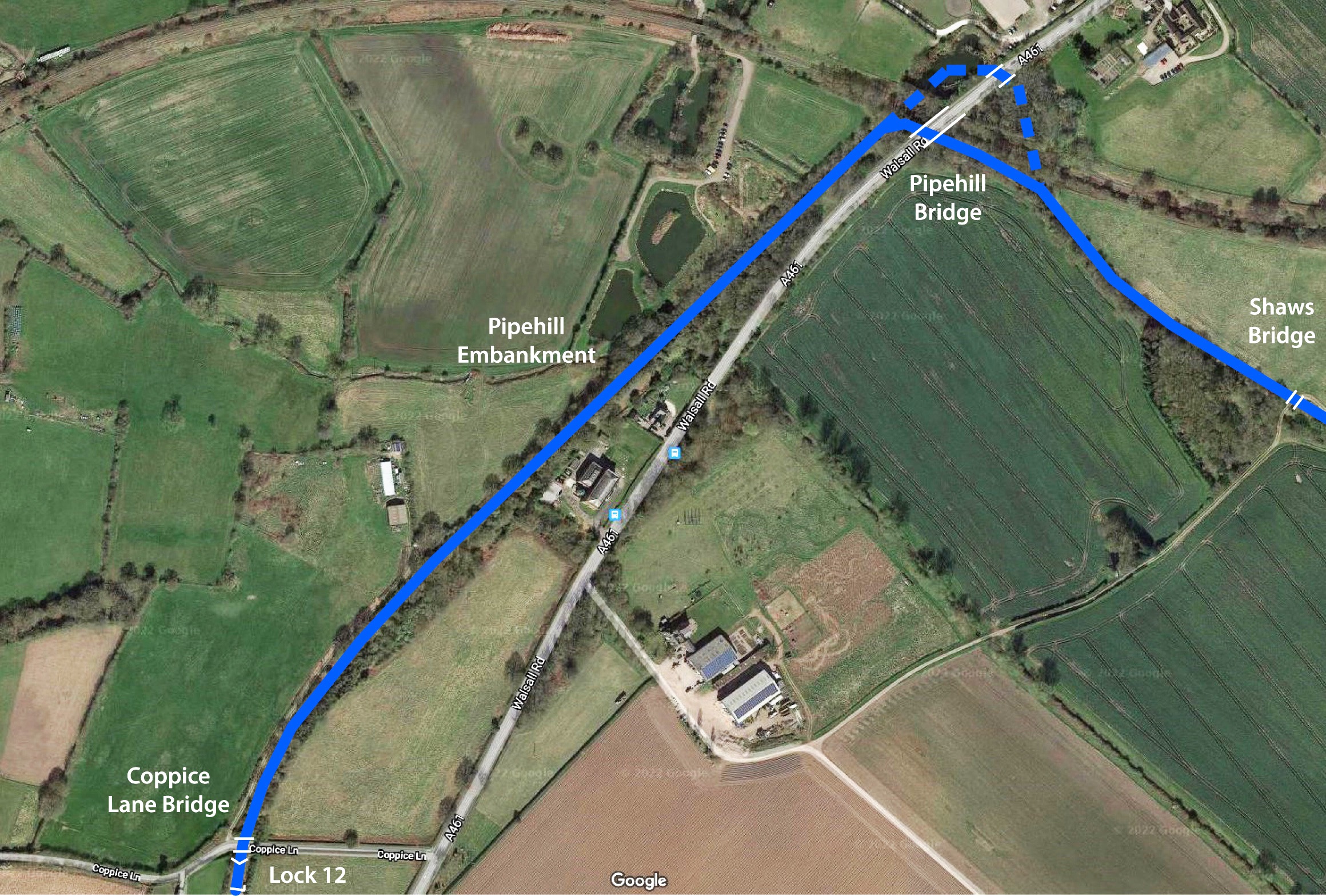
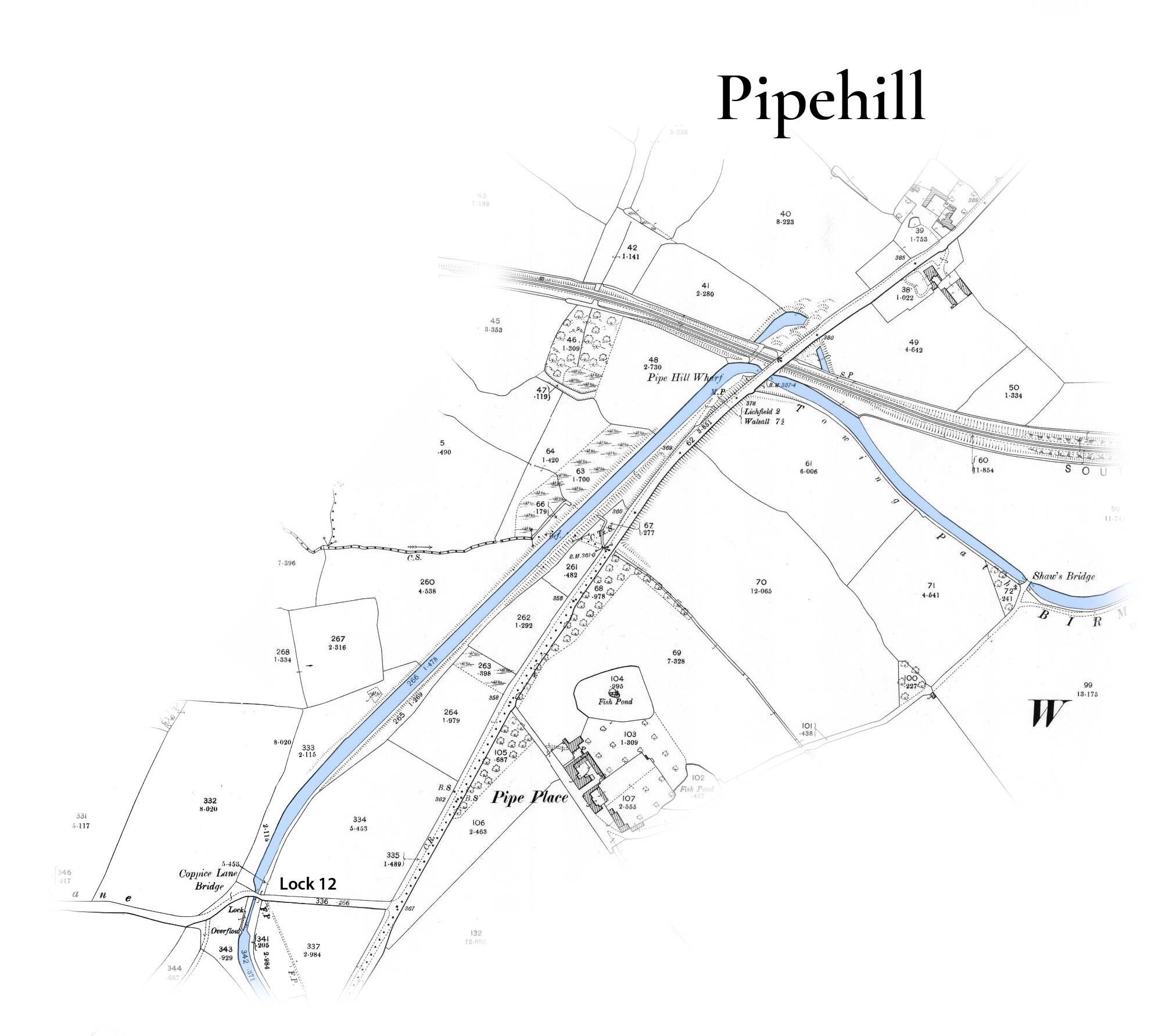
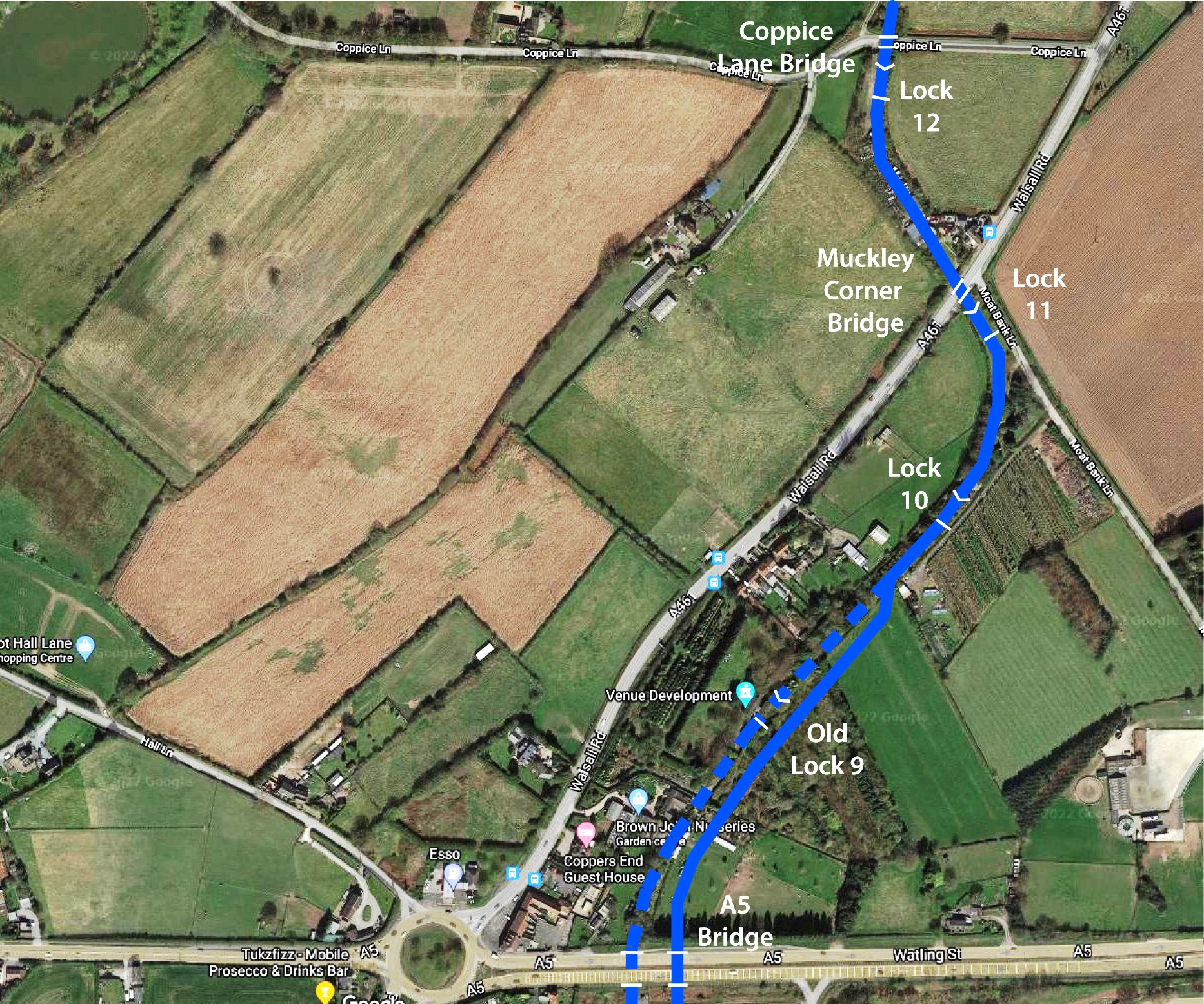
Beyond Coppice Lane bridge is the infilled Lock 12 and above the channel will need to be dug out as far as the A461 bridge which survives intact. Immediately beyond the bridge lies the infilled Lock 11 and a little further along Lock 10, both of which lie in a nursery. In the last few weeks the DoE volunteers have begun some clearance work on this length.
Lock 9 was the top lock of the second flight, but this will need to be relocated to solve the two biggest challenges on this length of restoration, the A5 and the A461 Boat Bridge crossings. The channel will need to be moved slightly to the south east of its current alignment and the fall of Lock 9 split in two. The first half will be located just to the South of the A5 to give headroom to get under the dual carriageway, the other half will need to be moved to the far side of the A461, Boat Bridge, to get under that dual carriageway. This will mean the channel will have to be lowered by half a lock for the length across Wall Butts Common between the A5 and the A461. Access will also be provided for the end of the gardens which will run down the canal which currently run to the road.
The next section at Summerhill (from the A461 to the M6 Toll Aqueduct) has been cleared and the towpath reinstated, an attractive and rural stretch except for the M6 Toll Road roaring down the valley. At the end of this section the Trust has rebuilt the culvert and embankment that carried the canal over the Crane Brook. After the Crane Brook is one of the most impressive feats of the project to date, the aqueduct installed to carry the canal over the M6 Toll. The aqueduct crosses the road about two locks higher than the level of the original bed, meaning that Locks 7 and 8 will need to be combined into a new deep lock just before the aqueduct with added back pumping to provide enough water.
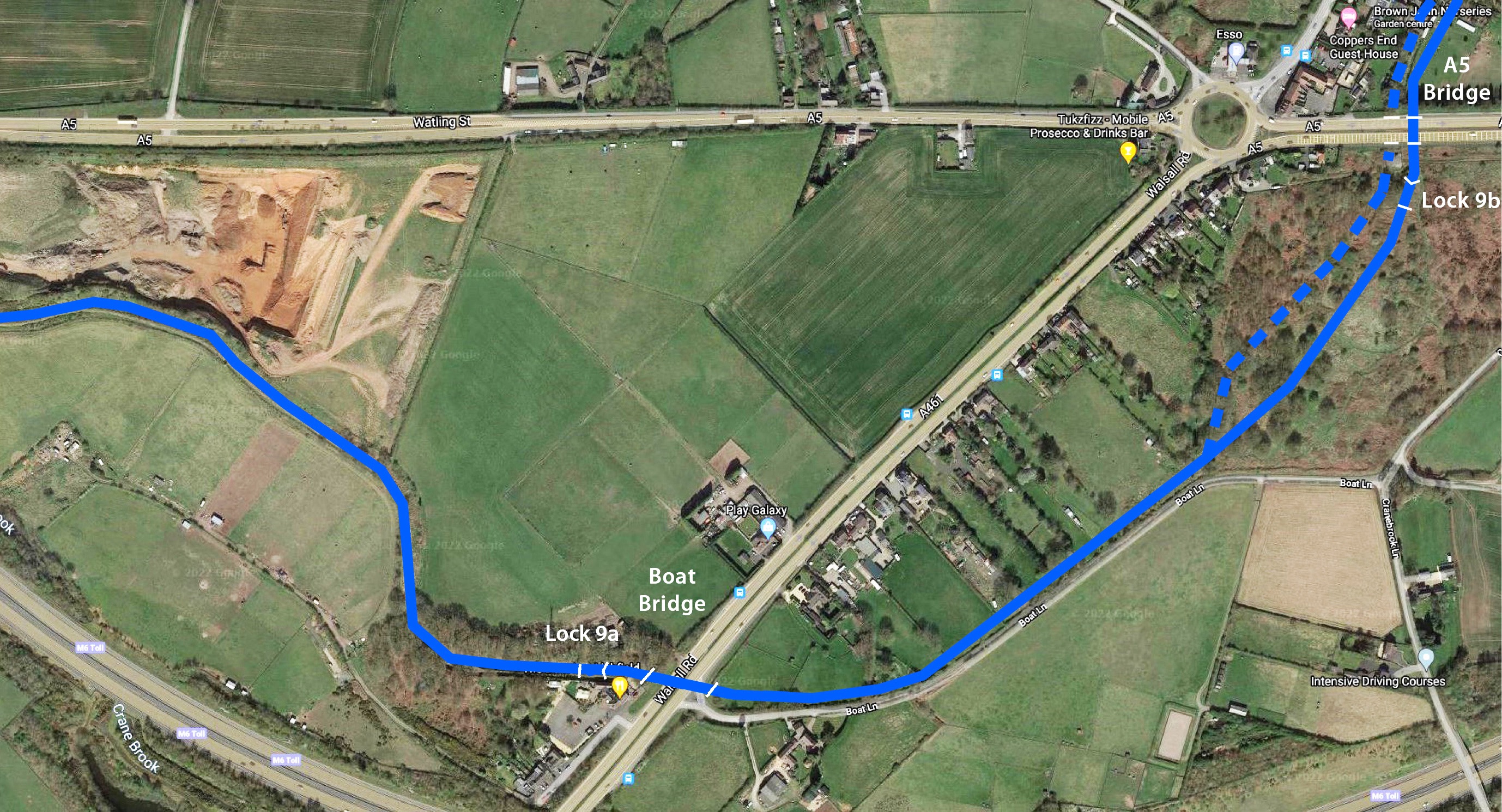

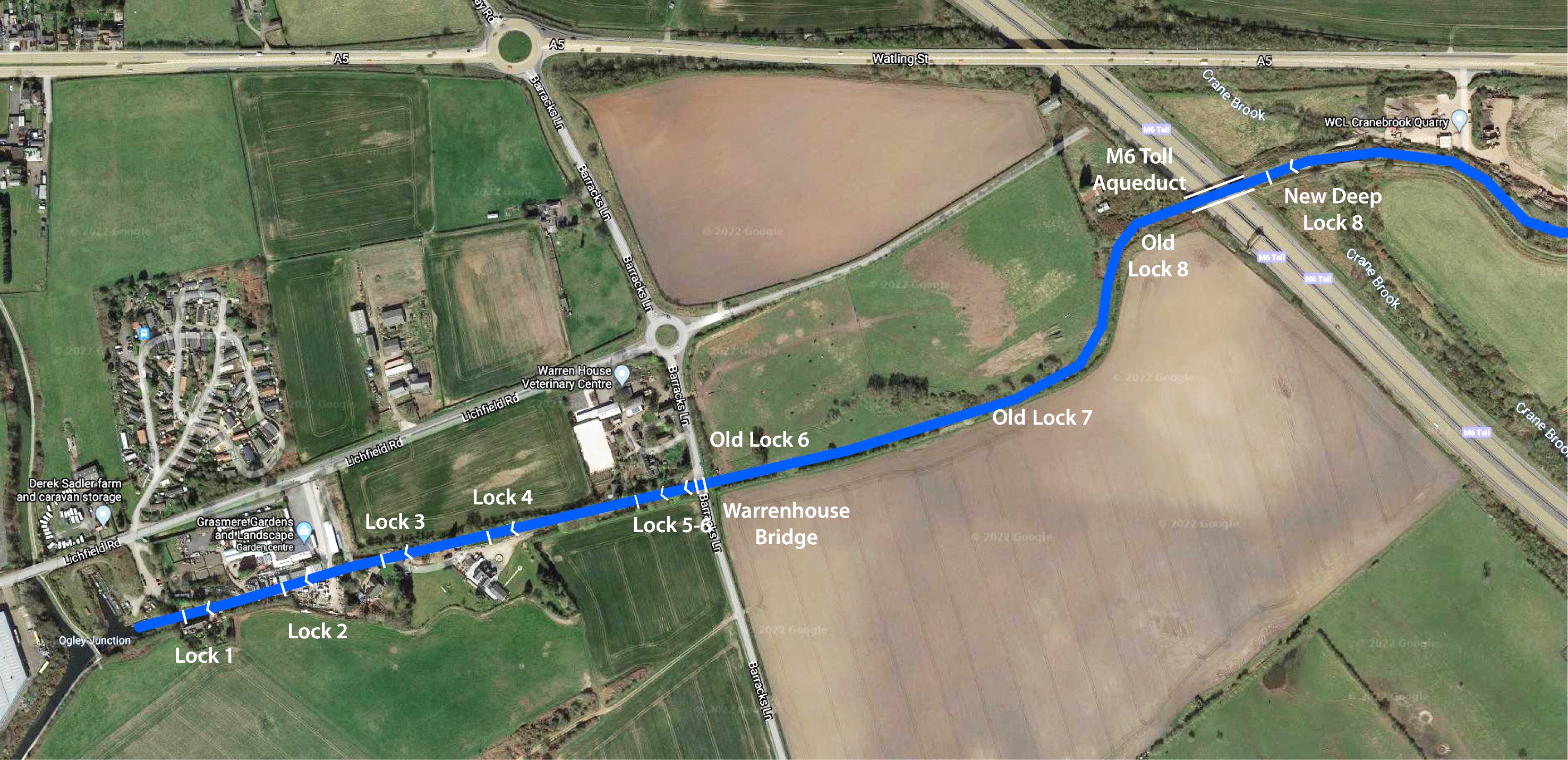
An embankment will then need to be built to carry the restored channel over old Lock 8, the bottom of the first flight from Ogley Junction, and reconnect with the original level at old Lock 7 which, like old lock 24, will become narrows.
The canal, which had a wide side pound, then comes to Lock 6, Barracks Lane and Warrenhouse Bridge and immediately after to Lock 5. Warrenhouse Bridge was a steep hump-backed bridge which was demolished in the 70’s. Around the bridge are drives accessing the farm and a house built over the side pound of Lock 4. This means it may be necessary to move Lock 6 to the other side of the bridge and make it into a staircase pair with Lock 5 in order to get under Barracks Lane.
The trust will need to provide a new access for a number of the properties alongside the top four locks and for the privacy of the owners, will have to move the towpath to the other side of the canal. The locks themselves were again infilled fairly soon after the canal was closed and are likely to be in reasonable condition under the infill.
The locks here all had large side pounds which cannot be used as two properties have been built on them so a different solution will be required, either back-pumping or creating links with pipes to resited side pounds. Helped by a generous grant from the Manifold Trust, the trust was able to buy the two cottages by the top lock, along with the infilled chamber, which they currently rent out.
This completes the journey from Huddlesford up to Ogley Junction. As mentioned, other than the A5 and A461 dual carriageways, this section contains considerably fewer engineering challenges than the lower half of the canal. However, much more of this length lies in private ownership and so progress on this section will require more negotiation and land purchase.

Compiled by Duncan Moore 2022